Showing posts with label Salmonella. Show all posts

Sunday, December 13, 2015

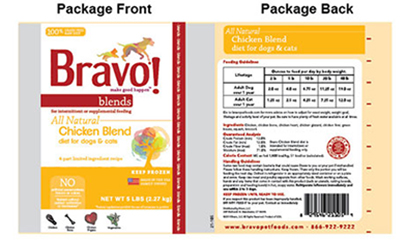
Bravo Pet Foods of Manchester, CT, is recalling a select lot of Bravo Chicken Blend diet for dogs & cats due to the possible presence of Salmonella

..
http://www.wales.nhs.uk/sitesplus/gallery/888/salmonella3.jpg
Public Health Wales
 
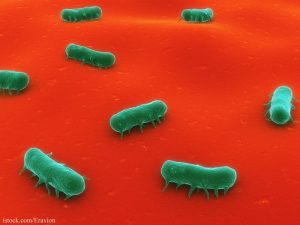
Salmonella is a bacterium of which more than 2400 different types (called serotypes) have been identified. The bacterium can be found in the gastrointestinal tract of wild and domestic animals, birds (especially poultry), reptiles, amphibians (for example, terrapins), and occasionally humans.
 
Infection with salmonella can cause watery and sometimes bloody diarrhoea, abdominal pain, headache, nausea, vomiting, and fever. Salmonella is one of a number of organisms that gives rise to illness collectively known as 'food poisoning'


............................................................................................


Food Safety News

Bravo Recalls Pet Food for Possible Salmonella Contamination


Bravo pet food label
 
 
Bravo Pet Foods of Manchester, CT, is recalling a select lot of Bravo Chicken Blend diet for dogs & cats with a best-used-by date of 11/13/16 due to the possible presence of Salmonella. Bravo is also recalling three additional items that did not test positive for Salmonella but were manufactured on the same day.These products were sold to distributors, retail stores, Internet retailers, and directly to consumers in the U.S.The following product is being voluntarily recalled because of the possible presence of Salmonella:
ProductItem #SizeBest Used by DateUPC
Bravo Blend Chicken diet for dogs & cats – chub21-1022 lb.(32oz.) chub11-13-16829546211028

The recall was initiated after routine testing of a 2-lb. chub of Bravo Chicken Blend diet for dogs and cats (Item #21-102) by the Colorado State Department of Agriculture and collected at a single retailer revealed the presence of Salmonella. Two hundred and one cases of this product were sold to distributors, retail stores, and directly to consumers in the U.S. between 11/21/14 and 1/15/15.


Read More Here

Friday, September 25, 2015

Nationwide Salmonella outbreak linked to imported Andrew & Williamson cucumbers

Cucumber Salmonella Outbreak Not Andrew & Williamson’s First

The nationwide Salmonella outbreak linked to imported Andrew & Williamson cucumbers is not the first illness outbreak linked to produce imported by that company. In 1997, a hepatitis A outbreak that sickened 260 faculty members and students in four different school districts in Calhoun county, Michigan was linked to strawberries sold by A&W. One student needed a liver transplant after this outbreak.


Andrew & Williamson Produce Outbreaks

A report that was part of a TED talk at American University states that strawberries served in school lunches “were traced to a processing plant in San Diego, known as Andrew and Williamson.” The company shipped strawberries from the same lot to schools in five other states, including Arizona, southern California, Georgia, Iowa, and Tennessee.
As a result, the CDC and local officials set up clinics in the schools, giving the children immune globulin shots to protect them against the disease. Hundreds  of children had to be immunized as a result of this outbreak, even though the vaccinations were limited to children who ate the fruit.

Read More Here

..........

California Hardest Hit by Deadly Cucumber Salmonella Outbreak

California has been hardest hit by the Salmonella Poona outbreak linked to cucumbers imported by Andrew & Williamson Fresh Produce. At least 120 people are sick in that state, and one person has died. Andrew & Williamson is based in San Diego, California.


Salmonella photo

That state originally warned consumers about the outbreak on September 4, 2015, the day that Andrew & Williamson recalled the product. Government officials informed the company that there was an epidemiologic association between the cucumbers and the outbreak. The San Diego County Health and Human Services Agency found one of the outbreak strains on cucumbers that were collected from the Andrew & Williams facility.

Read More Here
..........

Salmonella in Cucumbers Sickens 85 in Arizona, 1 Dead

Salmonella in cucumbers has sickened at least 85 people in Arizona, killing one of them, according to the Arizona Department of Health Services. The cases, which have been reported from Apache, Coconino, Maricopa, Pima, Pinal, and Yuma counties,  are part of a 33-state outbreak that has sickened 558 people.
Salmonella in cucumbers at Red Lobster 

The outbreak has been linked to cucumbers grown in Mexico and distributed in the U.S. by Andrew & Williamson Fresh Produce of San Diego, California.  Three strains of Salmonella Poona are associated with this outbreak. Four state health departments – Arizona, California, Montana, and Nevada – have isolated Salmonella from Andrew & Williamson cucumbers collected from various locations. The Nevada, Arizona and Montana health departments have all isolated outbreak strains from cucumbers collected from retail locations. And the San Diego County Health and Human Services Agency isolated one of the outbreak strains from cucumbers collected from the Andrew & Williamson Fresh Produce facility.


..........

Wednesday, April 16, 2014

Recall of Peppercorns for Salmonella in Canada Updated

Updated Food Recall Warning – Pusateri’s Fine Foods brand Organic Whole Black Peppercorns recalled due to Salmonella

Updated Food Recall Warning – Pusateri’s Fine Foods brand Organic Whole Black Peppercorns recalled due to Salmonella

NEWSCANADA-PLUS                             HEALTH  SAFETY  --       Updated Food Recall Warning - Pusateri's Fine Foods brand Organic Whole Black Peppercorns recalled due to Salmonella


Ottawa, April 12, 2014 – The food recall warning issued on April 5, 2014 has been updated to include an additional product.Organic Connections Ltd. is recalling Pusateri’s Fine Foods brand Organic Whole Black Peppercorns from the marketplace due to possible Salmonellacontamination. Consumers should not consume the recalled product described below.


Recalled products

Brand NameCommon NameSizeCode(s) on ProductUPC
Pusateri’s Fine FoodsOrganic Whole Black Peppercorns245 gLot # 040203-0026 28240 51655 8


Enhanced by Zemanta

Saturday, March 1, 2014

In Canada, Sprouts Recalled for Possible Salmonella

In Canada, Aquafuchsia Foods is recalling alfalfa sprouts because they may be contaminated with Salmonella bacteria. The sprouts were sold in Quebec. No illnesses associated with the consumption of this product have been reported to date.

Read More Here

.....

Food Recall Warning – Aquafuchsia brand alfalfa sprout product recalled due to Salmonella

NEWSCANADA-PLUS                                HEALTH-SAFETY  NEWS  –  health  safety  ---    Food Recall Warning - Aquafuchsia brand alfalfa sprout product recalled due to Salmonella


Recall details

Ottawa, February 25, 2014 – Aquafuchsia Foods Inc. is recalling Aquafuchsia brand alfalfa sprout product from the marketplace due to possibleSalmonella contamination. Consumers should not consume the recalled product described below.
The following product has been sold in Quebec.

Recalled products

Brand Name Common Name Size Code(s) on Product UPC
Aquafuchsia Salad Plus – Alfalfa with a touch of radish! 125 g 041 0 551176 1

What you should do

Check to see if you have recalled product in your home. Recalled product should be thrown out or returned to the store where it was purchased.

Read More Here

.....
Enhanced by Zemanta

Thursday, February 20, 2014

Minnesota Salmonella Outbreak associated with a Maygrove Restaurant


Daily Herald


Article posted: 2/17/2014 5:30 AM

Salmonella outbreaks expose weaknesses in USDA oversight


Noah Craten of Glendale, Ariz., is shown after surgery at Cardon Children’s Medical Center in Mesa, Ariz., in October. An infection in his bloodstream had caused abscesses on his brain. Tests by state health officials showed he had been infected with a strain of Salmonella Heidelberg.
Noah Craten of Glendale, Ariz., is shown after surgery at Cardon Children's Medical Center in Mesa, Ariz., in October. An infection in his bloodstream had caused abscesses on his brain. Tests by state health officials showed he had been infected with a strain of Salmonella Heidelberg.
 
Courtesy of Amanda Craten
 1 of 1 


By Kimberly Kindy and Brady Dennis

The Agriculture Department inspector showed up at Rick Schiller's home last November to collect potential evidence from his freezer: three pounds of chicken thighs, wrapped in plastic and stamped with a Foster Farms label.

Schiller, a 51-year-old California advertising executive, had recently returned from a five-day stay in the hospital, prompted by severe vomiting, diarrhea and an infection that left his joints throbbing and his right leg purple and twice its normal size.

Advertisement

"I've been around the block. I've had some painful things," he said. "But nothing like this."

State lab tests run on Schiller had already confirmed the diagnosis: a salmonella infection linked to Foster Farms chicken, part of a widespread outbreak that has food-safety advocates and some public health officials warning about the potential for food-borne illnesses to become more and more severe in the age of antibiotic-resistant "superbugs."

Federal regulators and poultry companies are scrambling to find new ways to reduce salmonella contamination, which sickens a million Americans annually. And the Agriculture Department is planning to expand rules to limit salmonella on chicken parts, not just whole birds.

But food-safety groups say this doesn't go far enough and the USDA should ban the most perilous salmonella strains from poultry altogether. Poultry processors have resisted such an approach, arguing that it would be expensive and ultimately futile, because salmonella is so pervasive.

The salmonella strain that sent Schiller to the hospital — a type known as Heidelberg — has been linked to numerous outbreaks in recent years, including the one at Foster Farms, which officially has sickened 430 people in 23 states.

The pathogen has sent double the usual rate of victims to hospital emergency rooms, one reason the Centers for Disease Control and Prevention called dozens of experts and investigators back to work during the government shutdown last fall to more closely track the outbreak. Some strains of Heidelberg also have proved resistant to several types of commonly prescribed antibiotics.

"This isn't your grandmother's salmonella," said Sarah Klein, an attorney for Center for Science in the Public Interest (CSPI), a nonprofit health watchdog group.

Noah Craten was 18 months old when he ended up in an Arizona children's hospital last October after an unshakable fever that lasted nearly a month. Doctors eventually discovered that an infection in his bloodstream had caused abscesses on the boy's brain. Surgeons had to slice open his scalp and cut open a piece of his skull to remove them.

After three weeks in an isolated hospital room and countless doses of antibiotics, Noah returned home in early November. Tests run by state health officials showed he had been infected with a Heidelberg strain, linked to the Foster Farms outbreak.

Cases similar to Noah's prompted the CSPI to file a petition with the USDA in 2011, outlining legal arguments for why it believes certain strains of salmonella should be banned because they present acute health risks.

The petition points to the USDA's own efforts with dangerous, drug-resistant E. coli strains, beginning with its ban a decade ago of E. coli 0157:H7.

The agency declared a zero-tolerance policy for the strain in many beef products after hundreds of Americans fell ill and four children died in 1993 after eating tainted hamburger meat from fast-food chain Jack in the Box.

As researchers eventually identified other types of E. coli that were particularly virulent and resistant to antibiotics, those likewise got labeled "adulterants" by the USDA, meaning the agency considers them dangerous substances that should be banned from commerce. A ban gives the USDA legal authority to order recalls, something it does not have with salmonella.

The result: Over time, deaths and infections from E. coli have decreased significantly.

"It worked," said Seattle lawyer Bill Marler, who specializes in food poisoning cases and is representing Schiller. "Ninety-five percent of my cases used to be E. coli. Today it is nearly zero. The industry will kick and scream, but they can fix it."

The chicken industry has long argued that it would not be realistic to expect processors to do away with salmonella on raw meat and that consumers must bear some responsibility in appropriately preparing it.

"Eliminating bacteria entirely is always the goal. But in reality, it's simply not feasible," said Tom Super, a spokesman for the National Chicken Council. "No legislation or regulation can keep bacteria from existing. … The only way to ensure our food is safe 100 percent of the time is by following science-based procedures when raising/growing, processing, handling and cooking it."

Both salmonella and E. coli can be killed by cooking meat to the appropriate temperature, but the USDA has determined that the risks are too great to place that responsibility on the shoulders of consumers when it comes to the more dangerous E. coli strains.

CSPI and epidemiologists hope that by expanding this approach to select salmonella strains the industry will be provided with the incentive it needs to scale back on the overuse of antibiotics on the farm. Experts say this practice has contributed to the rise of superbugs, both in animals and in humans.

As George Washington University epidemiologist Lance Price explains it, as more and more antibiotics are used on chickens, some types of salmonella are better able than others at surviving the bacteria-killing treatments.

"It's like someone is shooting at the bacteria and some of them have put on bulletproof vests," Price said. "The bacteria with the bulletproof vests are going to be the ones that survive."

Read More Here

.....

Pritzker Law.com

Maple Grove Restaurant Associated with MN Salmonella Enteritidis Outbreak

Attorney Ryan Osterholm is leading our law firm’s investigation of a Salmonella Enteritidis outbreak associated with a Maple Grove, Minnesota, restaurant. The specific food responsible for the cluster of Salmonella infections (salmonellosis) has not been determined.
Ryan and our team of Salmonella lawyers are looking at whether there is a connection with a nationally distributed product. If so, there may be illnesses associated with other locations in Minnesota and other states.

Read More Here

.....

Food Poisoning Bulletin

MN Salmonella Outbreak May Be Linked to Maple Grove Restaurant

A Salmonella outbreak in Minnesota may be linked to a restaurant in Maple Grove, Food Poisoning Bulletin has learned. A cluster of Salmonella Enteritidis infections has been identified and may be linked to a restaurant about 30 miles northwest of the Twin Cities metropolitan area.
Salmonella outbreak may linked to a Maple Grove restaurant.A potential source of the outbreak has not yet been identified. Health officials are collecting environmental samples from the restaurant and stool samples from those who were sickened. Tests on the samples will determine the genetic fingerprint of the Salmonella, allowing health officials to determine if the isolates from the patients are a match to any of the samples from the restaurant.

Read More Here

.....
Enhanced by Zemanta

Sunday, February 16, 2014

Foster Farms Salmonella Outbreak Sickened 134 in 13 States. Costco recalls 40,000 pounds of rotisserie chicken

Raw-Chicken-BreastThe first of two Salmonella outbreaks linked to Foster Farms chicken during 2013 was announced by the Centers for Disease Control and Prevention (CDC) one year ago this weekend. The outbreak sickened 134 people in 13 states, 33 people were hospitalized.
Most of those sickened, 71 percent, told health investigators that they had eaten Foster Farms chicken before they developing symptoms of Salmonella poisoning which include abdominal cramps, nausea and diarrhea.  Shopper card records showed nine case patients purchased Foster Farms chicken before illness onset.

Read More Here

.....

Costco recalls 40,000 pounds of rotisserie chicken for salmonella risk

A Costco wholesale store in South San Francisco, Calif., is recalling nearly 40,000 pounds of rotisserie chicken products because the food may be linked to an outbreak of salmonella poisoning that now has sickened more than 300 people in 20 states, federal health officials said early Saturday. 
The Costco store at 1600 El Camino Real is recalling 8,730 Kirkland Signature Foster Farms rotisserie chickens and 313 units of Kirkland Farm rotisserie chicken soup, rotisserie chicken leg quarters and rotisserie chicken salad, according to a notice issued by the U.S. Department of Agriculture's Food Safety and Inspection Service. The products were sold directly to consumers between Sept. 11 and Sept. 23. 
The rotisserie chickens may have been contaminated with a type of Salmonella heidelberg rarely found in the United States, FSIS officials said. The strain is linked to an ongoing food poisoning outbreak associated with three Foster Farms poultry plants in Fresno and Livingston, Calif. The USDA issued a public health alert for products from the plant on Monday, but on Thursday agreed that the facilities could remain open if the company made promised food safety fixes. 
At least 317 people in 20 states have been sickened by the outbreak since March, according to an updated notice from the Centers for Disease Control and Prevention. Most of the cases have been in California, where 232 people have been reported ill. It is the second outbreak of salmonella Heidelberg tied to Foster Farms in less than a year. A previous outbreak sickened 134 people in 13 states.
Some of the seven strains of salmonella detected in the outbreak are drug-resistant, which has created hard-to-treat infections in some patients. About 42 percent of victims in the outbreak have been hospitalized, twice the typical rate for salmonella infections. 
The rotisserie chicken recall is limited to the single store, Craig Wilson, Costco's vice president for food safety, told NBC News on Saturday. One cooked bird tested positive for the rare salmonella strain, Wilson said.


.....
Enhanced by Zemanta

Saturday, August 10, 2013

Imported Chinese Tilapia Are Raised on Feces

WorldTruth.TV
1016724_10200558226613237_1800408619_n
Small farms, high demands and lax oversight are inspiring fish farmers in China and Southeast Asia to feed their fish, especially tilapia, with animal feces.
TRUE:
In many cases, fish farmed in Asia and imported to the US have been raised on diets of chicken and pig feces
Tilapia is a flat, white fish that comes in nearly a hundred different species, is cheap to raise, easy to cook and recently became the fourth most-commonly consumed fish in the United States, behind shrimp, tuna and salmon. About 82 percent of the United States' tilapia comes from China, according to USDA documents. But a simple online search of the subject reveals numerous alarming accusations involving Asian fish — particularly tilapia — being raised on diets of animal manure, and thus turning into magnets for food-borne illness. MSN News spoke with a leading food-safety scientist who said that, in fact, Chinese tilapia's reputation for being unsafe to eat is quite well-deserved.
"While there are some really good aquaculture ponds in Asia, in many of these ponds — or really in most of these ponds — it's typical to use untreated chicken manure as the primary nutrition," Michael Doyle, director of the Center for Food Safety at the University of Georgia said. "In some places, like Thailand for example, they will just put the chickens over the pond and they just poop right in the pond."
HV1
Asked to estimate what percentage of Chinese tilapia are raised using animal feces as food, Doyle said "I'd say roughly 50 percent."
Feeding fish animal feces makes them highly susceptible to bacterial infections like salmonella and E.coli, Doyle said. Furthermore, he said that the large amount of antibiotics that are given to the fish to ward off infections makes the strains of salmonella and E.coli that the fish do catch extremely hard to eliminate.
"It's incredible to see how much of these antibiotics are applied, and they leave large residues of antibiotics in the ponds," Doyle said. "We have multiple antibiotic-resistant strains of salmonella coming in with these fish."
Farmed fish now more common than farmed beef
Last month it was announced that farmed fish had overtaken farmed beef in terms of worldwide production for the first time in recorded history. This watershed moment for human food consumption was made possible by a vast network of fish-farming operations that allow enormous quantities of seafood to be raised in a minimal area and with minimal resources.
According to reports, in China and other Asian countries like Vietnam and Thailand, intense demand for farmed fish and cutthroat competition among farmers drives many of these farmers to cut corners. Feeding the fish with pig and chicken feces is much cheaper than using standard fish food.
An explosive Bloomberg News story published in October of last year and headlined "Asian Seafood Raised on Pig Feces Approved for U.S. Consumers" revealed in graphic detail fish farms and packing plants in China and Vietnam that are rife with filth and disease, and U.S. inspectors doing what appeared to be a poor job of stopping the tainted fish from entering the food supply. According to the piece, 27 percent of seafood consumed in in the United States comes from China, and yet the FDA only inspects 2.7 percent of the fish that gets imported. Of the fish inspected, the FDA has reportedly rejected 820 Chinese seafood shipments since 2007, including 187 that contained tilapia.


Enhanced by Zemanta