Showing posts with label Food Safety. Show all posts

Sunday, December 20, 2015

Woodland’s Pork Mountain Ham Recalled for lack of Inspection from 2009 to 2015


Food Poisoning Bulletin

Woodland’s Pork Mountain Ham Recalled for lack of Inspection

Recall Sign

The Cure House of Louisville, Ky.  is recalling an undetermined amount of cured pork products that were produced without the benefit of federal inspection, according to the U.S. Department of Agriculture’s Food Safety and Inspection Service (FSIS) announced today. Consumers who have purchased this product should not eat it.

The recalled cured ham items were produced from 2009 thru Dec. 19, 2015. They were sold in various weights, individually wrapped labelled “Woodland’s Pork Mountain Ham.”  The code  “Est. 44888” inside the USDA mark of inspection. They were shipped to distributors in Kentucky and New Jersey.


Read More Here


.............................................................................................
The Curehouse
Facebook Page

Curehouse and Woodlands Pork products can be obtained through our distributors, Fossil Farms, in all E. Coast destinations, and by mail order http://www.fossilfarms.com
 
 
Exotic meats and organic meat available online from Fossil Farms. Our online meat store offers the best in organic, exotic meats and game, including ostrich…
fossilfarms.com

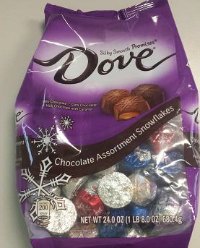
Dove Snowflakes Recalled for Undeclared Peanuts, Wheat and Egg Sold at Walmart


Food Poisoning Bulletin


dove-snowflakes-recall

Dove Snowflakes, recalled for the undeclared allergens peanuts, wheat and egg, were sold at Walmart. Consumers with sensitivities or allergies to these ingredients should not eat them as they could experience a serious reaction.


Read More Here

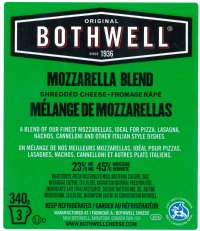
Canada - Bothwell Cheese Inc. is recalling shredded cheeses for possible Listeria monocytogenes contamination


Food Poisoning Bulletin

In Canada, Bothwell Cheese Recalled for Listeria

Bothwell CheeseInc. is recalling shredded cheeses for possible Listeria monocytogenes contamination. Consumers who have purchased these cheeses should not eat them as Listeria can cause serious illness.

bothwell-cheese-recall

The recalled cheeses were sold in Quebec, Manitoba and Saskatchewan. They include: White Cheddar Shred, Old Cheddar Shred, Mild Shred and Old Shred in 10kg packages with Lot # 151030. And Mozzarella Blend Shredded Cheese in 340g packages with lot number Lot # 160626 Best Before JUN 26 16 and UPC 0 58898 34082 1.


Read More Here

Sunday, December 13, 2015

Bravo Pet Foods of Manchester, CT, is recalling a select lot of Bravo Chicken Blend diet for dogs & cats due to the possible presence of Salmonella

..
http://www.wales.nhs.uk/sitesplus/gallery/888/salmonella3.jpg
Public Health Wales
 
Salmonella is a bacterium of which more than 2400 different types (called serotypes) have been identified. The bacterium can be found in the gastrointestinal tract of wild and domestic animals, birds (especially poultry), reptiles, amphibians (for example, terrapins), and occasionally humans.
 
Infection with salmonella can cause watery and sometimes bloody diarrhoea, abdominal pain, headache, nausea, vomiting, and fever. Salmonella is one of a number of organisms that gives rise to illness collectively known as 'food poisoning'


............................................................................................


Food Safety News

Bravo Recalls Pet Food for Possible Salmonella Contamination


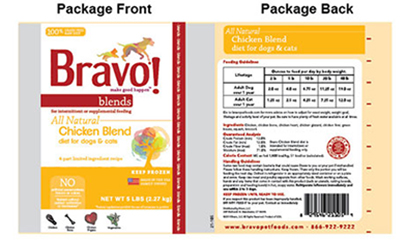
Bravo pet food label
 
 
Bravo Pet Foods of Manchester, CT, is recalling a select lot of Bravo Chicken Blend diet for dogs & cats with a best-used-by date of 11/13/16 due to the possible presence of Salmonella. Bravo is also recalling three additional items that did not test positive for Salmonella but were manufactured on the same day.These products were sold to distributors, retail stores, Internet retailers, and directly to consumers in the U.S.The following product is being voluntarily recalled because of the possible presence of Salmonella:
ProductItem #SizeBest Used by DateUPC
Bravo Blend Chicken diet for dogs & cats – chub21-1022 lb.(32oz.) chub11-13-16829546211028

The recall was initiated after routine testing of a 2-lb. chub of Bravo Chicken Blend diet for dogs and cats (Item #21-102) by the Colorado State Department of Agriculture and collected at a single retailer revealed the presence of Salmonella. Two hundred and one cases of this product were sold to distributors, retail stores, and directly to consumers in the U.S. between 11/21/14 and 1/15/15.


Read More Here

Hawaii Recalls Korean Raw Oysters After Reports of Norovirus Illnesses

Norwalk.jpg
Transmission electron micrograph of Norwalk virus. The white bar = 50 nm
EPA  ...Wikipedia.org
.............................................................................................

Food Safety News


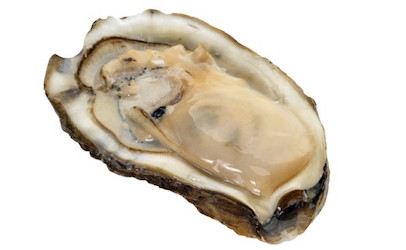
Raw oysters imported from Korea and sold in bulk to distributors and food establishments in Hawaii are being recalled.
 
The Hawaii State Department of Health (DOH) said the individually quick frozen (IQF) packaged under the Dai One Food Company label, with shellfish harvest dates of Feb. 10 -13, 2015, with shellfish tags on all shellfish cases are subject to the recall.
rawoyster_406x250


The department has already conducted product tracebacks and embargoed all of the suspect product on Nov. 24 at various local shellfish distributors and restaurants, said Peter Oshiro.

“Although this product is not sold directly to the public, a recall has been issued as an additional safeguard to further notify anyone who may possess the product that it is unsafe and should be destroyed,” he said.


Read More Here

Thursday, December 3, 2015

Taylor Farms Pacific Inc. of Tracy, Calif., has expanded its recall of celery linked to a dangerous strain of E. coli bacteria that has sickened 19 people in seven states.


undefined
User:Popolon         Wikimedia.org
............................................................................................................

Recall of celery tied to E. coli outbreak expands to 16 states


Liz Szabo
 A large California vegetable producer has expanded its recall of celery linked to a dangerous strain of E. coli bacteria that has sickened 19 people in seven states.
The celery was sold by Taylor Farms Pacific Inc. of Tracy, Calif., and was used as part of an onion and celery mix included in chicken salad at Costco stores. Now, the FDA has expanded the recall to a dozen retail chains in 16 states.
In addition to Costco's chicken salad, the celery was used in sandwiches, wraps, vegetable trays, cornbread stuffing and other items sold at a variety of stores. Affected stores include 7-Eleven, King Soopers, Raley's, Save Mart, Albertsons, Safeway, Vons, Starbucks, Target, Walmart and Sam's Club.

Read More Here

Monday, November 30, 2015

AquaBounty’s genetically modified (GMO) salmon facing further backlash from national grocery stores and restaurant chains : Costco and Red Lobster Say No to GMO Salmon


Costco and Red Lobster Say No to GMO Salmon

| November 25, 2015 9:21 am |
 
 
The U.S. Food and Drug Administration’s (FDA) controversial approval of AquaBounty’s genetically modified (GMO) salmon has garnered further backlash from national grocery stores and restaurant chains.

Costco, the second largest retailer in the world with 487 stores and one of the largest retailers of salmon and seafood in the U.S., has made a firm commitment not to sell GMO salmon.


gmosalmonfight750


“Although the FDA has approved the sale of GM salmon, Costco has not sold and does not intend to sell GM salmon at this time,” the company said in a statement.

Costco’s move to reject GMO salmon comes after vehement opposition from anti-GMO activists.
According to a statement from Friends of the Earth, Walmart and Publix are among the last remaining large retail grocers in the U.S. that have not yet rejected GMO salmon.

“The market is rejecting GMO salmon. Stores won’t sell it and people don’t want to eat it,” said Friends of the Earth Campaigner Dana Perls. “Now other retailers like Walmart and restaurants need to follow suit, and we need mandatory GMO labeling so that consumers know how to avoid GMO salmon.”

More than 60 grocery store chains representing more than 9,000 stores across the U.S. have made commitments to not sell GMO salmon, including Safeway, Kroger, Target, Trader Joe’s, Whole Foods, Aldi and many others.

The nation’s largest seafood restaurant is also denying GMO salmon. Red Lobster, with 705 North American locations and more than 40 internationally, told the Dallas Morning News that it would not sell GMO salmon last Friday.

Incidentally, consumers might not even know they’re eating GMO salmon. AquaBounty’s salmon, which is genetically altered to grow to market size in half the time of conventional salmon, will not require a GMO label under FDA guidelines.

It’s unclear if we’ll  ever see labels for genetically altered food, period—not just salmon. Currently, the hotly contested Safe and Accurate Food Labeling Act—dubbed by opponents as the Denying Americans the Right to Know Act or DARK Actlanguishes in the Senate.

The act, H.R. 1599, which passed the House of Representatives in July, bans states from issuing mandatory labeling laws for foods containing GMOs. The bill gives the FDA the authority to establish national standards and regulations for GMO food. The Department of Agriculture would be granted full discretion over the law’s implementation.


Read More Here

Tuesday, November 24, 2015

More than 1,000 customers were potentially exposed to Hepatitis A after having their meal at McDonald’s , prompting class-action lawsuit in Waterloo, New York


 Health Nut News

1,000 McDonald’s Customers Exposed To Hepatitis A, Sparking Class Action Lawsuit

People buying fast-food from McDonald's Restaurant

In November, more than 1,000 customers were potentially exposed to Hepatitis A after having their meal at McDonald’s prepared by an employee who was recently diagnosed (Nov. 13th) with the virus. The employee who works at a location in Waterloo, New York, could have contaminated food, utensils or dishes if they didn’t wash their hands after using the bathroom. The Seneca County Health Department has advised the community that if they ate at the Waterloo McDonald’s on Nov. 2nd, 3rd, 5th, 6th and or 8th, that they need to be tested and vaccinated.


However, one customer is suing.

The branch’s owner, Jascor Inc., is being sued by Christopher Welch in a class-action lawsuit, filed on Nov. 18th, for potentially exposing people to the virus, which causes liver infections. Mr. Welch ate at the restaurant on at least one occasion when the worker was present so he received the vaccination. Some of the customers who ate there during that time have said they will get tested but not get the vaccine.

According to the Centers for Disease Control and Prevention (CDC):

 
Read More Here

Monday, November 16, 2015

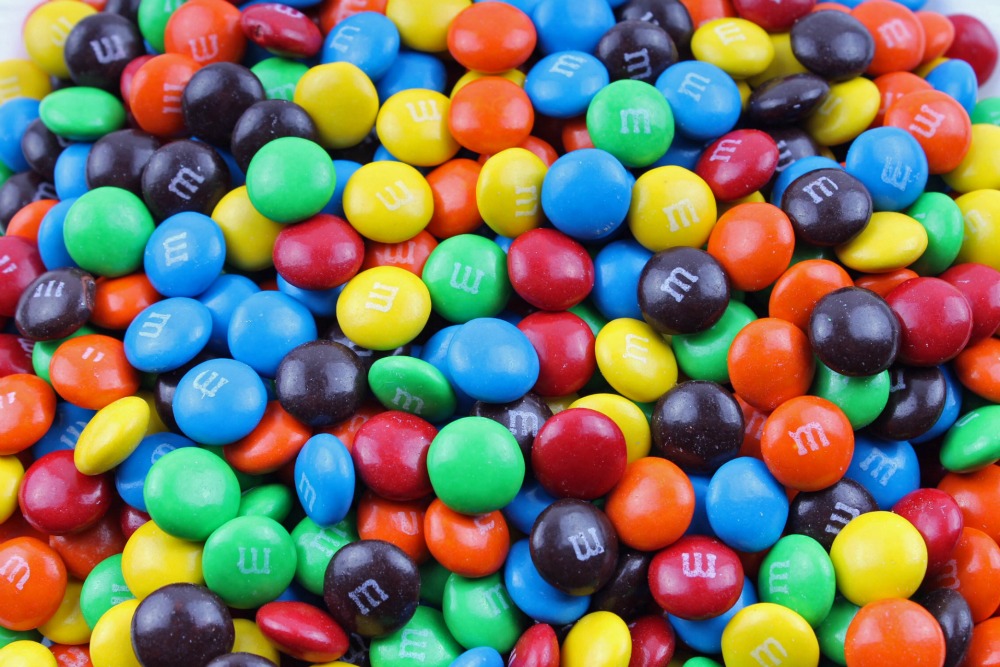
M&M’S are a tempting treat few can refuse. Did you know they are linked to a number of debilitating health conditions?


Natural Blaze

5 Debilitating Health Conditions Linked To M&M’S Candies


MM-Bulk
By Amanda Froelich


With a crunchy shell and sweet, milk chocolate inside, M&M’S are a tempting treat few can refuse. Unfortunately, the sweet candies are far from healthy and are created with ingredients that are linked to a number of debilitating health conditions.

As Living Traditionally reports, ingredients used in the manufacturing of the candies are linked to everything from cancer, migraines, and hyperactivity to allergies and anxiety. 

The chocolaty treat has an intriguing history. Created by Mars Inc., the candies were dreamt up in 1941 as a way to allow soldiers to carry chocolate without worry of it melting.

Over the years, its iconic logo and humorous advertising have made it a favorite in over 100 countries. With ingredients that have been found to adversely affect health, however, it’s time consumers get educated on what they’re actually consuming and opt for healthier cacao treats if a sweet fix is in order.

An Original M&Ms bag lists the following ingredients:

Milk chocolate (sugar, chocolate, cocoa butter, skim milk, milk fat, lactose, soy lecithin, salt, artificial color), sugar, cornstarch, >1% corn syrup, dextrin, artificial colors (Blue 1 Lake, Red 40 Lake, Yellow 6, Yellow 5, Red 40, Blue 1, Blue 2 Lake, Yellow 6 Lake, Yellow 5 Lake, Blue 2), gum acacia.


Read More Here

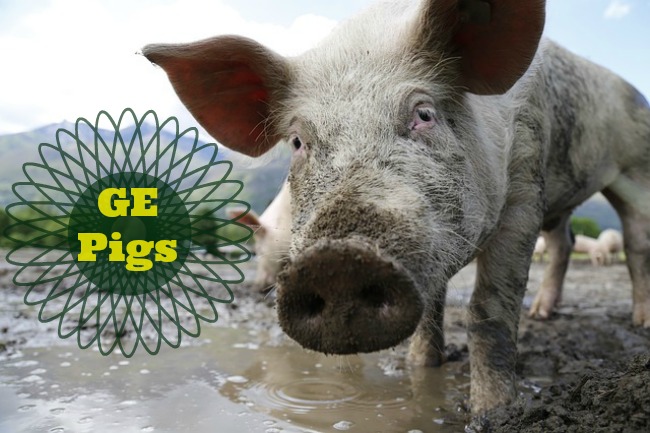
Hmmmm Factor..... Did you think the genetically modified pig was gone? Think Again.


Natural Blaze

Two New GE Pigs Want to Go To the Market


pig-752555_640

By Heather Callaghan


Did you think the genetically modified pig was gone? It is true that Canada’s “Enviro Pig” was scrapped in 2012 after consumer backlash and lack of university funding. That vacancy mainly left genetically modified salmon in the running to become the very first commercial GM animal.
But there are two new types of engineered pigs poised for approval in their respective countries. Now, with the secret Trans Pacific Partnership out in the open, it becomes clear that the deal opens the door for a swarm of global biotech ventures that can more easily glide their wares across country boundaries.

Whereas Enviro Pig’s genetic splicing was supposedly intended to cut down on phosphorous waste that kills waterways, two more pigs are vying for public acceptance.

It’s important to note that these animals aren’t “transgenic” like many of the GE crops on the market. That is, they do not contain genes from other species or kingdoms like bacteria. Biotech involves more than GMOs, and some methods currently fall outside of regulation or definition. However, we are still talking genetic engineering.


CBC News reports on them:

  • Bruce Whitelaw and his colleagues at the University of Edinburgh are developing a pig resistant to African swine fever, a devastating disease with no vaccine or cure that has led to hundreds of pigs being slaughtered in Europe to prevent its spread.
  • Jinsu Kim and his colleagues at Seoul National University have developed “double-muscle” pigs that produce twice as much muscle as a regular pig, resulting in higher protein, lower fat pork.


Read More Here

.....................................................................................................

CBC News

Genetically modified pigs raise concerns about food regulation

Regulatory system lacks transparency, critics say

CBC News Posted: Nov 03, 2015 11:50 AM ETLast Updated: Nov 04, 2015 8:59 AM ET


Two kinds of genetically modified pigs are on their way to becoming pork on our dinner plates. If they do, they'll be some of the very first genetically modified animals to enter our food system.
Two kinds of genetically modified pigs are on their way to becoming pork on our dinner plates. If they do, they'll be some of the very first genetically modified animals to enter our food system. (Laszlo Balogh/Reuters)


Close


The Current: GMO pigs' cautionary tale of genetically modified food research 24:43


Two kinds of genetically modified pigs are on their way to becoming pork on our dinner plates. If they do, they'll be some of the very first genetically modified animals to enter our food system, along with genetically modified salmon that is also trying to gain regulatory approval.

But consumers are wary and lack confidence in governments' readiness to regulate this new class of food product, researchers and activists say.

The genetically modified pigs under development are designed to improve pork production in different ways:

  • Bruce Whitelaw and his colleagues at the University of Edinburgh are developing a pig resistant to African swine fever, a devastating disease with no vaccine or cure that has led to hundreds of pigs being slaughtered in Europe to prevent its spread.
  • Jinsu Kim and his colleagues at Seoul National University have developed "double-muscle" pigs that produce twice as much muscle as a regular pig, resulting in higher protein, lower fat pork.

In both cases, researchers have precisely targeted an individual pig gene to create a mutation that turns up or turns down certain genes. The African swine fever resistant pig has an immune gene that is slightly more like a warthog's. The double-muscle pig has a mutation similar to one produced by normal breeding in a muscly cow breed called the Belgian blue.

The pigs aren't "transgenic" — that is, they don't contain genes from other organisms. That makes them unlike some genetically modified crops already on the market, which may contain genes from organisms such as bacteria.


Read More Here


Related Stories

Tuesday, November 3, 2015

E. Coli Outbreak : All Chipotle restaurants in a four county region in Oregon and all in Washington state have closed.


The Oregon Health Authority released a statement today saying that there is an E. coli outbreak linked to Chipotle restaurants in Washington state and Oregon. At least 19 people are sick in Washington and 3 are ill in Oregon.


E. coli Photos


Eight of those sickened have been hospitalized in this outbreak. No one has died. The patient age range is from 11 to 64 years old. Those sickened live in Clackamas and Washington counties in Oregon, and in Clark, King, Skagit, and Cowlitz counties in Washington. The patients have reported eating at six of the restaurants in those states.

If you or someone you know ate at any Chipotle restaurant in the Northwest between October 14 and 23, 2015 and has been sick with vomiting and bloody diarrhea, see your health care provider. Mention this outbreak.

All Chipotle restaurants in the four county region in Oregon have been voluntarily closed.  All of the Chipotle restaurants in Washington state have closed.

Read More Here

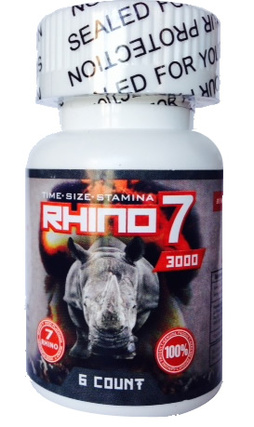
Rhino Dietary Supplements Recalled for Unapproved Drugs


Food Poisoning Bulletin

Rhino dietary supplements are being recalled because they contain undeclared drugs and may be a health hazard. FDA analysis found that the products contain undeclared desmethyl carbondenafil and dapoxetine. Desmethyl carbondenafil is a phosphodiesterase PDE-5 inhibitor, a class of drugs used to treat male erectile dysfunction, making these products unapproved new drugs. Dapoxetine is an active ingredient not approved by the U.S. Food and Drug Administration (FDA). No reports of adverse effects have been received to date.
Desmethyl carbondenafil can interact with nitrates found in some prescription drugs such as nitroglycerin and may lower blood pressure to life-threatening levels. Dapoxetine has not been approved for use by the FDA. This chemical is an SSRI used to treat depression, which can increase the risk of suicidal thinking and ideation in children, young adults, and adolescents.

Read More Here

Thursday, October 29, 2015

Skippy peanut butter recalled over possible metal shavings


Reuters
Anjali Athavaley

 ...
File:Fool's Gold Loaf (8720348111).jpg
Mr. Granger    A Fool's Gold Loaf sandwich.  Wikimedia.org
..................................................................................................

Hormel Foods said Thursday it's voluntarily recalling a limited number of jars of its Skippy peanut butter in seven U.S. states because they might contain small pieces of metal shavings.

The recall involves 153 cases, or 1,871 pounds, of Skippy Reduced Fat Creamy Peanut Butter Spread. It is limited to 16.3 ounce jars with a "Best If Used By" date of DEC1416LR1 with a package UPC code of 37600-10500.

The jars were sent to distribution centers for Publix , Target and Walmart located in Georgia, Virginia, Alabama, North Carolina, South Carolina, Delaware and Arkansas, Hormel said.


Read More Here

Tuesday, October 27, 2015

Consumer Advisory Issued for Uncle John’s Apple Cider for E. coli


The Michigan Department of Agriculture and Rural Development issued a consumer advisory for Uncle John’s Old Fashioned Apple Cider produced by Uncle John’s Cider mill in St. Johns, Michigan because it may be contaminated with Shiga toxin-producing E. coli bacteria. A random sample collected by a government inspector tested positive for the pathogenic bacteria. No illnesses have been reported to date in connection with the consumption of this product.

Apple Cider

The recall is for about 1,200 gallons of cider produced on October 17, 2015. The cider was sold at the cider mill from the retail cooler, packaged in various sized plastic jugs with a sell-by date of October 30, 2015, or served directly to consumers by the cup as cold cider, frozen cider slushes, and hot cider from October 18 through October 21, 2015. The company has stopped selling cider while awaiting more test results.


Read More Here

What Caused E. coli Contamination in High Hill Ranch Apple Juice?


Unpasteurized apple juice sold at High Hill Ranch in Camino, California has sickened at least seven people with E. coli infections, according to the El Dorado County Environmental Management and Public Health division. All of the patients live in Sacramento County and all consumed the product from the ranch in mid October this year.

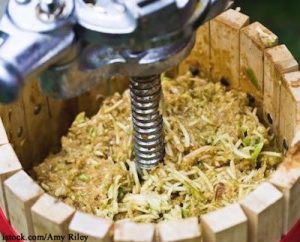
Pressing Apple CiderOne person has been hospitalized and is expected to recover. The juice was consumed at home or at High Hill Ranch. Officials are warning consumers to not drink any unpasteurized apple juice purchased from the ranch on or after October 6, 2015.

Unpasteurized apple juice, just like unpasteurized milk, has caused E. coli outbreaks in the past. An outbreak in Michigan in 2012 linked to unpasteurized juice sickened people. And an outbreak in Canada last year that sickened people with E. coli infections was linked to the unpasteurized beverage.

These products can be contaminated with E. coli bacteria and other pathogenic bacteria. Pasteurization destroys the bacteria in those products and makes them safe to drink. While the FDA requires that unpasteurized apple juice have a warning label that tells consumers about the risks of drinking that product, that warning is not required on juice that is freshly squeezed and served to the public at orchards, farmers markets, roadside stands, and in some restaurants or juice bars.


Read More Here


HUMAN DNA found in popular hot dog and sausage brands and 10% of vegetarian varieties contain meat


Hotdogs   Jersyko
Wikimedia.org
..............................................................................................................................


  • Analysis examined 345 samples from 75 brands sold at ten food retailers
  • DNA was in two per cent of all samples, predominantly in veggie products 
  • Found ten per cent of vegetarian hot dogs and sausages contained meat
  • Clear Food study found 14.4 per cent of hot dogs or sausages had issues
  • Americans spent more than $5.5billion on hot dogs and sausages in 2014
A study exposed some issues with veggie hot dogs
Human DNA - or deoxyribonucleic acid - has been found in two per cent of hot dogs and sausages, a major study of popular brands has revealed 
Tests on 345 samples from different 75 brands also revealed ten per cent of vegetarian hot dogs contain meat.
Out of the samples that tested positive for DNA (seven), 66 per cent (four) were vegetarian.
The genetic material that was found could have come from a hair, a fingernail, a dribble of spit or a drop of blood.
Twenty-one vegetarian products were tested overall. 
The genetic testing analysis carried out by Clear Food, which looked at major brands and regional favorites being sold by ten retailers, did not specify which brands contained the human DNA or what caused the contamination.

Read More Here

Sunday, October 18, 2015

New England Journal of Medicine article by Renowned Children’s Health Expert calls for GMO labels on foods


MassLive


New England Journal of Medicine article calls for GMO labels on foods

 
roundup.jpg
Roundup is a product of Monsanto. (Republican file)


on August 20, 2015 at 11:33 AM, updated August 20, 2015 at 11:48 AM

A Perspective article published today in the New England Journal of Medicine calls for the labeling of genetically modified foods.

"We believe the time has come to revisit the United States' reluctance to label GM foods," writes Dr. Philip J. Landrigan, co-author with Charles Benbrook, of the article entitled "GMOs, Herbicides, and Public Health."

The two write that such labeling "is essential for tracking emergence of novel food allergies and assessing effects of chemical herbicides applied to GM crops."

"It would respect the wishes of a growing number of consumers who insist they have a right to know what foods they are buying and how they were produced," the two write.

"And the argument that there is nothing new about genetic rearrangement misses the point that GM crops are now the agricultural products most heavily treated with herbicides and that two of these herbicides may pose risks of cancer."

The article also calls for the Environmental Protection Agency to delay its permit to allow the use of Enlist Duo, what the article refers to as "a new combination herbicide" that has been "formulated to combat herbicide resistance" to such agents as glyphosate (Roundup).

Read More Here

..........

Environmental Working Group

Citing GMO-Herbicide Link, Renowned Children’s Health Expert Calls for GMO Labeling

Thursday, August 20, 2015

An article published today in the prestigious New England Journal of Medicine by two of the nation’s most respected experts on pesticides and children’s environmental health calls for the Food and Drug Administration to require mandatory labeling of genetically engineered (GMO) food.
This comes after the House of Representatives passed a bill last month that would block states from enacting their own labeling laws and make it nearly impossible for the FDA ever to implement national mandatory labeling of genetically engineered foods.

Titled “GMOs, Herbicides, and Public Health,” the paper by Philip J. Landrigan, M.D. and Charles Benbrook, Ph.D. focuses on the widespread adoption of GMO crops across the U.S. and the resulting explosion in the use of toxic herbicides – some of them, like Monsanto’s glyphosate, linked to cancer – and argues that labeling these foods is a matter of protecting public health.

Landrigan and Benbrook write that since being introduced in the mid-1990s, 90 percent of U.S.-grown corn and soy has been engineered to tolerate being doused with weed-killing herbicides, resulting in an enormous increase in the use of herbicides:
Widespread adoption of herbicide-resistant crops has led to overreliance on herbicides and, in particular, on glyphosate. In the United States, glyphosate use has increased by a factor of more than 250 – from 0.4 million kg [kilograms] in 1974 to 113 million kg in 2014.
As a result of the overreliance on glyphosate, weeds have increasingly become resistant to the weed killer, forcing growers to add other herbicides, including 2,4-D, to control them. The Environmental Protection Agency recently approved the sale of Enlist Duo, a new weed-killer made by Dow AgroSciences that combines glyphosate and 2,4-D. Landrigan and Benbrook argue that the agency’s risk assessment of the product relied on flawed science:
The science consisted solely of toxicologic studies commissioned by the herbicide manufacturers in the 1980s and 1990s and never published, not an uncommon practice in U.S. pesticide regulation. These studies predated current knowledge of low-dose, endocrine-mediated, and epigenetic effects and were not designed to detect them. The risk assessment gave little consideration to potential health effects in infants and children, thus contravening federal pesticide law.

Read More Here

Thursday, October 15, 2015

Italy and Austria join growing list of countries banning GMO agriculture. EU Committee Wants to Demolish their right to do so.


NaturalNews's profile photo
NaturalNews

Italy and Austria join growing list of countries banning GMO agriculture


EU

(NaturalNews) European nations are leading the world in rejecting genetically modified organisms in food and crops, with two more countries recently joining the list: Italy and Austria.

As reported by Nation of Change, Italian ministries have opted to utilize the newly created European Union rules that permit member countries to opt out of growing GM crops. Austrian officials joined in as well, with both nations making the decision to stop growing eight varieties of GM maize, which essentially amounted to a complete ban on GM crops.

The EU's opt-out regulations were implemented earlier this year. They allow member states to decide on their own if they want to continue using GM crops or ban them altogether.

As reported by Sustainable Pulse, a number of other countries in the EU have also opted out of GM crops:

Wales: "These new rules proposed by the European Commission provide Wales with the necessary tools to maintain our cautionary approach by allowing us to control the future cultivation of GM crops in Wales," said Welsh Deputy Minister for Farming and Food, Rebecca Evans. "It will allow us to protect the significant investment we have made in our organic sector and safeguard the agricultural land in Wales that is managed under voluntary agri-environment schemes."

She added: "Farming and food processing businesses remain the driving force of our rural economy. Our emphasis is on competing on quality, strong branding and adding value through local processing. We, therefore, need to preserve consumer confidence and maintain our focus on a clean, green, natural environment. "

Poland: In 2013, the Polish government actually adopted a regulation that banned GMO farming in the country, well ahead of the EU action. But once the EU approved its regulation giving member nations the right to ban if they chose, that was more than enough authority for the Polish government to act.

"Now we no longer have to explain the scientific aspects and we can already relate to social issues," Polish Agriculture Minister Marek Sawicki said at the time of the country's ban.

Germany: German government officials announced in late September that the country would no longer permit the cultivation of GM crops, as stated by German Agriculture Minister Christian Schmidt.

Slovenia: Slovenian Agriculture Minister Dejan Zidan said in announcing the country's ban that "the government adopted the decision for a request for the exclusion of the entire geographical territory of Slovenia for GM maize to the EU, including the already registered variety MON 810 and seven other varieties which are in the process of registration with the European Commission. This allows me to formally send the request as the Ministry of Agriculture in accordance with the law for the exclusion of Slovenia with the regards to the cultivation of GM maize."

Serbia: State Secretary in the Serbian Ministry of Agriculture and Environmental Protection Danilo Golubovic recently announced the country's GMO ban. In making the announcement, Golubovic said the decision was based on a desire to improve public health and safety.

Bulgaria: This government has decided to burnish its clean and green image by banning GM crops. As noted by Sustainable Pulse's director, Henry Rowlands, "Bulgaria is home to a wide variety of unique flora and fauna and is also the base of many ancient civilizations, it is with this background that Bulgarians know what is at risk when it comes to using an untested and unnecessary technology."

European nations that have opted out of growing GM crops thus far are Latvia, France, Austria, Cyprus, Lithuania, the Netherlands, Scotland, Northern Ireland, Poland, Germany, Greece, Croatia, Hungary, Slovenia and Italy, Sustainable Pulse reported.

Sources:


BullHorn.NationOfChange.org


SustainablePulse.com


Reuters.com
EcoWatch.com

Reuters.com


About NaturalNews

The NaturalNews Network is a non-profit collection of public education websites covering topics that empower individuals to make positive changes in their health, environmental sensitivity, consumer choices and informed skepticism. The NaturalNews Network is owned and operated by Truth Publishing International, Ltd., a Taiwan corporation. It is not recognized as a 501(c)3 non-profit in the United States, but it operates without a profit incentive, and its key writer, Mike Adams, receives absolutely no payment for his time, articles or books other than reimbursement for items purchased in order to conduct product reviews.

The vast majority of our content is freely given away at no charge. We offer thousands of articles and dozens of downloadable reports and guides (like the Honest Food Guide) that are designed to educate and empower individuals, families and communities so that they may experience improved health, awareness and life fulfillment.

Learn More About Natural News Here

 
...................................................................................................


by Christina Sarich
Posted on October 15, 2015

 
gmo_corn_syringe_735_250

EU Committee Wants to Demolish Existing Law Allowing Member States to Ban GMOs

As 19 EU nations plan GMO bans


Stating a concern that the proposed law would lead to the reintroduction of border controls between GM and non-GMO-growing countries, the European Parliament news service reported that Members of the Environment Committee shot down a draft EU law that would allow member states to restrict or prohibit sales of genetically modified crops.

This vote goes against numerous EU states that have made it clear in recent months that they plan to instate total bans on GM crops. A total of 19 EU countries have sent letters to the EP saying that they plan GM bans, citing concern over spoiling agricultural markets, and also the desire to provide their citizens with organic food.


Sunday, October 11, 2015

Monsanto Lied? Say it ain't so .... The independent science Monsanto used to further its GMO agenda was actually executive solicited pro-GMO articles from university researchers.


Organic Consumers Association
Campaigning for health, justice, sustainability, peace, and democracy

The Emperor Has No Clothes, and Neither Do Monsanto’s ‘Scientists’

 
October 7, 2015
Organic Consumers Association
by Katherine Paul


The Monsanto public relations machine has done a stellar job in recent years of reducing the GMO debate to one that pits “pro-science advocates” against “anti-science climate-denier types”—with Monsanto portrayed as being squarely planted in the pro-science camp.

But that well-oiled machine may be starting to sputter.

Turns out that Monsanto executive solicited pro-GMO articles from university researchers, and passed the “research” off as independent science which the biotech giant then used to prop up its image and further its agenda.

We know this, thanks to thousands of pages of emails obtained by US Right to Know, under the Freedom of Information Act (FOIA). And because a host of news outlets—including the New York Times, the Boston Globe, Bloomberg, the StarPhoenix and others—are now running with the story.
For anyone who has paid attention, this latest scandal should come as no surprise. As Steven Druker writes, in “Altered Genes, Twisted Truth,”  “for more than 30 years, hundreds (if not thousands) of biotech advocates within scientific institutions, government bureaus, and corporate offices throughout the world have systematically compromised science and contorted the facts to foster the growth of genetic engineering, and get the foods it produces, onto our dinner plates.”

Will Druker’s book (published this year), and this new wave of bad press be enough to finally expose Monsanto’s “science” for what it is—nothing more than an expensive, sustained and highly orchestrated public relations campaign?

The story behind the story

U.S. Right to Know (USRTK), a nonprofit funded almost entirely by the Organic Consumers Association, launched an investigation into “the collusion between Big Food, its front groups, and university faculty and staff to deliver industry PR to the public.”

As part of its ongoing investigation, the group filed FOIA requests to obtain the emails and documents from 43 public university faculty and staff. The requested documents included records from scientists, economists, law professors, extension specialists and communicators—all of whom, as the group points out, were conducting work in public institutions, all funded by taxpayers.

Read More Here

Thursday, October 8, 2015

“As far as genetically-modified organisms are concerned, we have made the decision not to use any GMO in food productions.”, Russian Deputy Prime Minister Arkady Dorkovich


01.10.2015 Author: F. William Engdahl

Victory! World’s Largest Nation Bans GMO Food Crops


212678292 

Victories are to be celebrated and for the future of healthy life on our planet we all can celebrate a beautiful victory. The world’s largest nation, the Russian Federation, whose landmass spans Eurasia from the Baltic and Ukraine on the west to Vladivostock and the Pacific on her east, has formally declared all commercial planting of Genetically Modified Organisms, GMOs, to be prohibited. 

The issue has been subject of a heated debate for some months inside Russia. In February 2014, just days prior to the US-orchestrated coup d’etat in Ukraine, Russian Prime Minister Dmitry Medvedev created a national research project to obtain scientific information so the Government and Duma might make a decision on GMOs in Russia. Now a definitive decision has been made, and it goes against Monsanto and the US-led GMO cartel. We can say Russia’s crisis has concentrated minds on the essentials of life.

Russian Deputy Prime Minister Arkady Dorkovich told an international biotechnology conference in Kirov September 18, “As far as genetically-modified organisms are concerned, we have made the decision not to use any GMO in food productions.”

Last year the Duma or parliament voted to make tough GMO labeling laws as a first step to the new ban in order to inform consumers of presence of GMO in various foods they buy. That was before US and EU sanctions led to Russian counter-sanctions against EU imports of agriculture products. In August 2014, the Russian government announced its bans on import from the EU and several other countries of meat, fish, dairy products, fruit and vegetables as a response to the sanctions. It produced surprising results. Since the imposition of tough Russian food import bans, Russian agriculture has undergone a spectacular rebirth. 

Russian supermarkets from Rostov on Don to Sochi to Moscow today feature overwhelmingly Russian products, domestically grown. Russians I spoke with during a visit this August to the Rostov region told me they realized that the taste of Russian food such as tomatoes was far superior to that of imported food that often is artificially colored and treated with chemical preservatives that it holds on the shelf, looking fresh. Following the tumultuous collapse of the Soviet Union in the early 1990’s the corrupt Yeltsin government opened the doors for western agribusiness giants like Kraft, Nestle, Unilever to fill Russian stores with their agribusiness industrialized food products. 


Read More Here