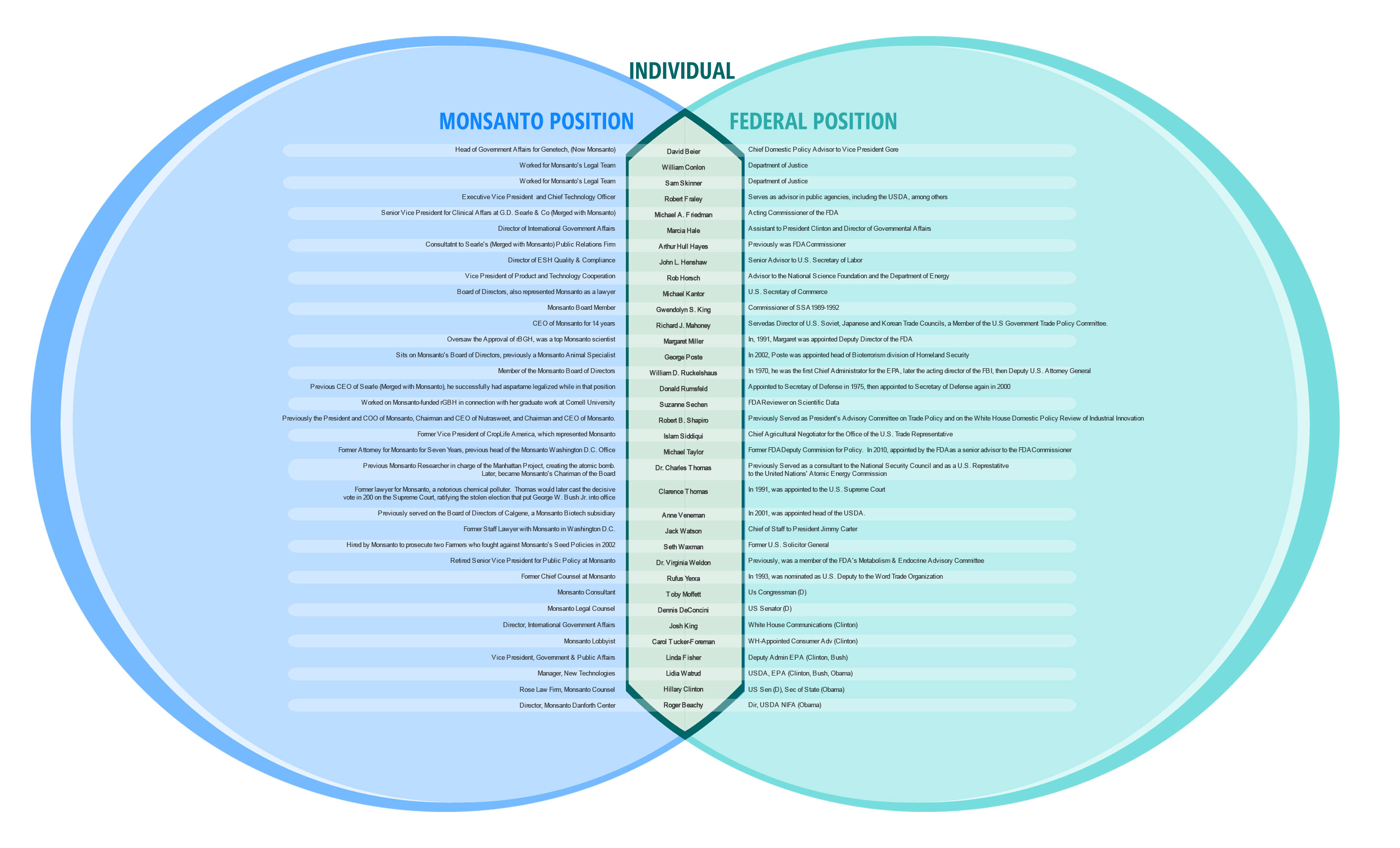
Over the years, this biotech giant has successfully infiltrated an ever
increasing number of high-level federal regulatory positions in the U.S.
government; many of which are positions meant to protect your food safety...
.....
Genetic Engineering Actually INCREASES Pesticide Use, DECREASES Crop Yield, And May Be Dangerous to Your Health
One of the main selling points for genetically engineered crops is that they would use
substantially less pesticides than conventional crops.
Because of that, and other, promises regarding GE crops, they have taken over much of the food crops in America. For example:
- The USDA reports that 93% of all soy and 85% of all corn grown in the U.S. is an herbicide-resistant GE variety
- Similarly, around 93% of all cottonseed oil and more than 90% of all canola oil produced in the U.S. is herbicide-resistant GE
However, it turns out that GE crops need
a lot more herbicides than conventional ones.
Washington
State University Charles Benbrook – former Executive Director of the
Board on Agriculture at the National Academy of Sciences and, before
that, Executive Director of the Subcommittee on Department Operations,
Research, and Foreign Agriculture, U.S. House of Representatives –
published a
study showing:
Contrary
to often-repeated claims that today’s genetically-engineered crops
have, and are reducing pesticide use, the spread of glyphosate-resistant
weeds in herbicide-resistant weed management systems has brought about substantial increases in the number and volume of herbicides applied. If new genetically engineered forms of corn and soybeans tolerant of 2,4-D are approved, the volume of 2,4-D sprayed [background] could drive herbicide usage upward by another approximate 50%.
***
Largely
because of the spread of glyphosate-resistant weeds, HR crop technology
has led to a 239 million kg (527 million pound) increase in herbicide
use across the three major GE-HR crops, compared to what herbicide use
would likely have been in the absence of HR crops.
Washington State University
explains:
Herbicide-tolerant
crops worked extremely well in the first few years of use, but
over-reliance led to shifts in weed communities and the emergence of
resistant weeds that have, together, forced farmers to incrementally –
- Increase herbicide application rates (especially glyphosate),
- Spray more often, and
- Add new herbicides that work through an alternate mode-of-action into their spray programs.
Each
of these responses has, and will continue to contribute to the steady
rise in the volume of herbicides applied per acre of HT corn, cotton,
and soybeans.
HT crops have increased herbicide use by 527 million
pounds over the 16-year period (1996-2011). The incremental increase
per year has grown steadily from 1.5 million pounds in 1999, to 18
million five years later in 2003, and 79 million pounds in 2009. In
2011, about 90 million more pounds of herbicides were applied than
likely in the absence of HT, or about 24% of total herbicide use on the
three crops in 2011.
Today’s major GE crops have increased overall
pesticide use by 404 million pounds from 1996 through 2011 (527 million
pound increase in herbicides, minus the 123 million pound decrease in
insecticides). Overall pesticide use in 2011 was about 20% higher on
each acre planted to a GE crop, compared to pesticide use on acres not
planted to GE crops.
There are now two-dozen weeds resistant to
glyphosate, the major herbicide used on HT crops, and many of these are
spreading rapidly. Millions of acres are infested with more than one
glyphosate-resistant weed. The presence of resistant weeds drives up
herbicide use by 25% to 50%, and increases farmer-weed control costs by
at least as much.
The biotechnology-seed-pesticide industry’s
primary response to the spread of glyphosate-resistant weeds is
development of new HT varieties resistant to multiple herbicides,
including 2,4-D and dicamba. These older phenoxy herbicides pose
markedly greater human health and environmental risks per acre treated
than glyphosate. Approval of corn tolerant of 2,4-D is pending, and
could lead to an additional 50% increase in herbicide use per acre on
2,4-D HT corn.
Science Daily
notes:
“Resistant
weeds have become a major problem for many farmers reliant on GE crops,
and they are now driving up the volume of herbicide needed each year by
about 25 percent,” Benbrook said.
Forbes
points out:
A new study
released by Food & Water Watch yesterday finds the goal of reduced
chemical use has not panned out as planned. In fact, according to the
USDA and EPA data used in the report, the quick adoption
of genetically engineered crops by farmers has increased herbicide use
over the past 9 years in the U.S. The report follows on the heels of
another such study by Washington State University research professor Charles Benbrook just last year.
Both
reports focus on “superweeds.” It turns out that spraying a pesticide
repeatedly selects for weeds which also resist the chemical. Ever more
resistant weeds are then bred, able to withstand increasing amounts –
and often different forms – of herbicide.
GE Crops Have Reduced Crop Productivity
GE food manufacturers also promised an increase in crop productivity. Indeed, that was a
giant selling point for GE foods.
That claim has been debunked as well …
The Independent
noted in 2008:
Genetic modification actually cuts the productivity of crops,
an authoritative new study shows, undermining repeated claims that a
switch to the controversial technology is needed to solve the growing
world food crisis.
The study – carried out over the past three
years at the University of Kansas in the US grain belt – has found that
GM soya produces about 10 per cent less food than its conventional
equivalent, contradicting assertions by advocates of the technology that
it increases yields.
Professor Barney Gordon, of the university’s
department of agronomy, said he started the research – reported in the
journal Better Crops – because many farmers who had changed over to the
GM crop had “noticed that yields are not as high as expected even under
optimal conditions”. He added: “People were asking the question ‘how
come I don’t get as high a yield as I used to?’”
***
Read More Here
.....
The promise by Monsanto and producers of genetically modified crops was
that farmers could use less chemicals and produce a greater yield.
That's about as true as honesty in politics. A study published this week
by Washington State University research professor Charles Benbrook
finds that the use of herbicides in the production of three genetically
modified herbicide-tolerant crops -- cotton, soybeans and corn -- has
actually increased.

This
counterintuitive finding is based on an exhaustive analysis of publicly
available data from the U.S. Department of Agriculture’s National
Agriculture Statistics Service. Benbrook’s analysis is the first
peer-reviewed, published estimate of the impacts of genetically
engineered (GE) herbicide-resistant (HT) crops on pesticide use.
It
is confirming earlier US government data showing that in the US, GM
crops have produced an overall increase, not decrease, in pesticide use
compared to conventional crops. Not only that promises of greater yields
are also unfounded.
GM crops have not increased the yield
potential of any commercialised crops. In fact, studies show that the
most widely grown GM crop, GM soya, has suffered reduced yields.
A
report that analyzed nearly two decades worth of peer reviewed research
on the yield of the primary GM food/feed crops, soybeans and corn
(maize), reveals that despite 20 years of research and 13 years of
commercialization, genetic engineering has failed to significantly
increase US crop yields. The author, former US EPA and US FDA biotech
specialist Dr Gurian-Sherman, concludes that when it comes to yield,
“Traditional breeding outperforms genetic engineering hands down.”
In the USDA study, which appeared in the the open-access, peer-reviewed journal “
Environmental Sciences Europe,”
Benbrook writes that the emergence and spread of glyphosate-resistant
weeds is strongly correlated with the upward trajectory in herbicide
use. Marketed as Roundup and other trade names, glyphosate is a
broad-spectrum systemic herbicide used to kill weeds. Approximately 95
percent of soybean and cotton acres, and over 85 percent of corn, are
planted to varieties genetically modified to be herbicide resistant.
Atrazine
is the second-most widely used herbicide in the U.S. More than 75
million pounds of it are applied to corn and other crops, and it is the
most commonly detected pesticide contaminant of groundwater, surface
water and rain in the U.S.
Men exposed to high amounts of the
substance are far more likely than men with less contact to have diluted
or deformed and sluggish sperm. Each of the semen problems can reduce
the ability of sperm to reach and fertilize an egg and could make
conception harder.
“Resistant weeds have become a major problem
for many farmers reliant on GE crops, and are now driving up the volume
of herbicide needed each year by about 25 percent,” Benbrook said.
Data
from the US Department of Agriculture indicate that the use of
glyphosate on major crops went up by more than 15 fold between 1994 and
2005. The EPA estimated in 2000-2001 that 100 million pounds of
glyphosate are used on lawns and farms every year, and over the last 13
years, it has been applied to more than a billion acres.
It did
not take long for glyphosate-resistant weeds to appear, just as weeds
resistant to every herbicide used in the past had appeared. The Weed
Science Society of America reported nine weed species in the United
States with confirmed resistance to glyphosate; among them are strains
of common ragweed (
Ambrosia artemisiifolia), common waterhemp (
Amaranthus rudis), giant ragweed (
Ambrosia trifida), hairy fleabane (
Conyza bonariensis), horseweed (
Conyza canadensis), Italian ryegrass (
Lolium multiflorum), johnsongrass (
Sorghum halepense), rigid ryegrass (
Lolium rigidum), and palmer pigweed (Amaranthus palmeri).
The
annual increase in the herbicides required to deal with
tougher-to-control weeds on cropland planted to GE cultivars has grown
from 1.5 million pounds in 1999 to about 90 million pounds in 2011.
Herbicide-tolerant
crops worked extremely well in the first few years of use, Benbrook’s
analysis shows, but over-reliance may have led to shifts in weed
communities and the spread of resistant weeds that force farmers to
increase herbicide application rates (especially glyphosate), spray more
often, and add new herbicides that work through an alternate mode of
action into their spray programs.
Natasha Longo
has a master's degree in nutrition and is a certified fitness and
nutritional counselor. She has consulted on public health policy and
procurement in Canada, Australia, Spain, Ireland, England and Germany.
.....