Monday, May 19, 2014

Hmmmm Factor : Coke and Pepsi used as pesticide in India. According to lab tests they exceed legal limits for insecticide

Prevent Disease


May 6, 2014 by JOHN SUMMERLY

Pepsi and Coca-Cola Used As Pesticide In India Because They're Cheap and Get The Job Done

Besides being an effective poison to the human metabolism, it seems Pepsi and Coca-Cola have another popular function in other parts of the world. One of India’s leading voluntary agencies, the Center for Science and Environment (CSE) said that soft drinks manufactured in India, including those carrying the Pepsi and Coca-Cola brand names, contain unacceptably high levels of pesticide residues and consequently many farmers have used the beverages to combat pests because of low costs compared to conventional pesticide brands.


It's cheaper and easier to buy Coke in some third world countries than it is to access clean water. Coke uses "public relations propaganda" to convince consumers and entire nations that it is an "environmental company" when really it is linked to pollution, water shortages, and disease.
Coke has been tested in many cleaning scenarios and can even compare to high strength brands to clean everything from oil stains, tile grout and even strip paint off furniture.
In 2003, the CSE analyzed samples from 12 major soft drink manufacturers that are sold in and around the capital at its laboratories and found that all of them contained residues of four extremely toxic pesticides and insecticides--lindane, DDT, malathion and chlorpyrifos.
"In all the samples tested, the levels of pesticide residue far exceeded the maximum permissible total pesticide limit of 0.0005 mg per liter in water used as food, set down by the European Economic Commission (EEC)," said Sunita Narain, director of the CSE at a press conference convened to announce the findings.
The level of chlorpyrifos was 42 times higher than EEC norms, their study showed. Malathion residues were 87 times higher and lindane- banned in the United States-21 times higher, CSE scientists said.
They added that each sample was toxic enough to cause long-term cancer, damage to the nervous and reproductive systems, birth defects, and severe disruption of the immune system. Samples from brand leaders Coca-Cola and Pepsi had almost similar concentrations of pesticide residues in the CSE findings. Contaminants in Pepsi samples were 37 times higher than the EEC limit while its rival Coca-Cola exceeded the norms by 45 times, the same findings showed.
The chiefs of the Indian subsidiaries of Coca-Cola and Pepsi were quick to refute the charges. Sanjeev Gupta, president of Coca-Cola India, called the revelations made by CSE "unfair" and said his company was being subjected to a "trial by media".

Cheaper

Farmers in the Durg, Rajnandgaon and Dhamtari districts of Chhattisgarh say they have successfully used Pepsi and Coke to protect their rice plantations against pests.
It is a trend that has been seen in other parts of India, with farmers also using Indian brands of colas.
The practice of using soft drinks in lieu of pesticides, which are 10 times more expensive, gained so much popularity that sales of the drinks increased drastically in remote villages.
Farmers say the use of pesticides costs them 70 rupees ($1.50) an acre.
By comparison, if they mix a bottle of Pepsi or Coke with water and spray it on the crop it costs 55-60 rupees less per acre.

Old Practice

Agricultural specialist Devendra Sharma says farmers are mistaken in thinking that the drinks are the same as pesticides.
He says the drinks are effectively sugar syrups and when they are poured on crops they attract ants which in turn feed on the larva of insects.
Mr Sharma says using sugar syrup for pest control is not a new practice.
"Jaggery made from sugar cane has been used commonly for pest control on many occasions. Pepsi and Coca-Cola are being used to achieve the same result," he says.
Fellow scientist, Sanket Thakur, has a different explanation: "All that is happening is that plants get a direct supply of carbohydrates and sugar which in turn boosts the plants' immunity and the plantation on the whole ends up yielding a better crop."
Coke in the United States contains high fructose corn syrup which may even prove to be a more effective pesticide since it is a concentrated cocktail of the simple sugars fructose and glucose.
Anupam Verma, Pepsi sales manager at the time in Chhattisgarh, said sales figures in rural areas of the state increased by 20%.

Not Only Cola, But Water Is The Problem 


CSE scientists H. B. Mathur and Sapna Johnson said their basic inference was that, as with the bottled mineral water, the soft drink manufacturers were drawing their water supplies from groundwater that is heavily contaminated by years of indiscriminate pesticide use.
High pesticide residues were reported in groundwater around Delhi at the time when the government's Central Ground Water Board (CGWB) and the Central Pollution Control Board (CPCB) carried out a study which also reported excessive salinity, nitrate and fluoride content besides traces of lead, cadmium and chromium.
Significantly, the CSE laboratories tested samples of soft drink brands popularly sold in the United States as control--and found that they did not contain any pesticide residue. Although more than 95% of all soft drink brands in the United States are made with municipal water supplies containing all of the same toxins and pharmaceuticals in our drinking water including fluoride, arsenic, chlorine, atenolol, atrazine, carbamazepine, estrone, gemfibrozil, sulfamethoxazole, and trimethoprim.
CSE found that the regulations for the powerful and massive soft drinks industry are much weaker, indeed non-existent, as compared to those for the bottled water industry. The norms that exist to regulate the quality of cold drinks are inadequate, leaving this "food" sector virtually unregulated.
So pampered is the lucrative soft drink sector that it is exempted from the provisions of industrial licensing under the Industries (Development and Regulation) Act, 1951.

Sources:
bbc.co.uk
ipsnews.net

John Summerly
is nutritionist, herbologist, and homeopathic practitioner. He is a leader in the natural health community and consults athletes, executives and most of all parents of children on the benefits of complementary therapies for health and prevention.

Enhanced by Zemanta

Biological Hazard - Denmark, [The area was not defined.]


Earth Watch Report  -  Biological Hazards

File:Neutrophil and Methicillin-resistant Staphylococccus aureus (MRSA) Bacteria.jpg

Scanning electron micrograph of neutrophil ingesting methicillin-resistant Staphylococcus aureus bacteria. Credit: NIAID   National Institutes of Health.
NIAID/NIH
Wikimedia.org

.....
May 13 2014 03:04 AMBiological HazardDenmark[The area was not defined.]Damage levelDetails

......

RSOE EDIS

Description
A troubling and also kind of odd story came out of Denmark this weekend. In a court proceeding, a microbiologist has disclosed that three residents of the country who had no known connection to farming died of MRSA infections caused by ST398, the livestock-associated strain of drug-resistant staph that first appeared among pig farmers in the Netherlands in 2004 and has since moved through Europe, Canada and the United States. If the report is correct - and sources have told me it is, but I've seen no data to confirm it - it reinforces the concern that bacteria which become resistant because of antibiotic use on farms can move off farms and affect the health of people who have no connection to farming. Livestock MRSA has always one of the best cases for establishing that, because the drug to which it showed the greatest resistance, tetracycline, wasn't used against human MRSA in the Netherlands, but was used routinely on farms - so the only place the strain could have picked up its unique resistance pattern was in pigs. (Here's my long archive of posts on pig MRSA, dating back to my book Superbug where the story was told for the first time.) Just to get them high up, here are some Danish news sources; this sees to have been a widely covered story. Danish isn't one of my languages, so I've relied on Google Translate - not the best practice, but there's enough agreement among the stories that I am comfortable with it in this case.
Biohazard name:MRSA (pig, human)
Biohazard level:3/4 Hight
Biohazard desc.:Bacteria and viruses that can cause severe to fatal disease in humans, but for which vaccines or other treatments exist, such as anthrax, West Nile virus, Venezuelan equine encephalitis, SARS virus, variola virus (smallpox), tuberculosis, typhus, Rift Valley fever, Rocky Mountain spotted fever, yellow fever, and malaria. Among parasites Plasmodium falciparum, which causes Malaria, and Trypanosoma cruzi, which causes trypanosomiasis, also come under this level.
Symptoms:
Status:confirmed

.....
 WIRED

Denmark: Three Deaths from Drug-Resistant “Pig MRSA”

ICStefanescu (CC), Flickr
A troubling and also kind of odd story came out of Denmark this weekend. In a court proceeding, a microbiologist has disclosed that three residents of the country who had no known connection to farming died of MRSA infections caused by ST398, the livestock-associated strain of drug-resistant staph that first appeared among pig farmers in the Netherlands in 2004 and has since moved through Europe, Canada and the United States.
If the report is correct — and sources have told me it is, but I’ve seen no data to confirm it — it reinforces the concern that bacteria which become resistant because of antibiotic use on farms can move off farms and affect the health of people who have no connection to farming.
Livestock MRSA has always one of the best cases for establishing that, because the drug to which it showed the greatest resistance, tetracycline, wasn’t used against human MRSA in the Netherlands, but was used routinely on farms — so the only place the strain could have picked up its unique resistance pattern was in pigs. (Here’s my long archive of posts on pig MRSA, dating back to my book Superbug where the story was told for the first time.)

Just to get them high up, here are some Danish news sources; this sees to have been a widely covered story. Danish isn’t one of my languages, so I’ve relied on Google Translate — not the best practice, but there’s enough agreement among the stories that I am comfortable with it in this case.
  • The Information: “Filthy use of antibiotics”
  • Kvalls Posten: “Resistant swine bacterium has killed three Danes”
  • DR DK: “Politicians are worried about swine bacteria”
  • Avisen: “Three Danes die of swine bacteria”
  • Ekstra Bladet: “Three died from killer bacteria from pigs”
  • Fyens: “University hospital physician: Three died of swine bacteria”

Read More Here
.....


Enhanced by Zemanta

Friday, May 16, 2014

The Highest Nutrient Dense Calcium Foods Are Not Dairy

Prevent Disease


May 6, 2014 by MARCO TORRES

You don't need milk or yogurt to benefit from highly bioavailable sources of calcium. In fact, contrary to popular belief, most dairy products do not possess any type of calcium that is easily absorbed in the body. Here are some of the best foods you can eat with both high nutrient density and high bioavailable calcium.

The pasteurization process involved in the manufacture of most dairy products creates calcium carbonate, which has absolutely no way of entering the cells without a chelating agent. When we drink milk, the body pulls the calcium from the bones and other tissues in order to buffer the calcium carbonate in the blood. This process weakens gradually weakens bones, not make them stronger. It's one of the reasons we have such high rates of osteoporosis in the United States.
Milk also has little to no nutrient density because pasteurization destroys enzymes, diminishes vitamin content, denatures fragile milk proteins, destroys vitamins C, B12 and B6, and kills beneficial bacteria. It's the main reason pasteurized milk promotes pathogens and is associated with allergies, increased tooth decay, colic in infants, growth problems in children, osteoporosis, arthritis, heart disease and cancer.
Many natural food sources have high bioavailable calcium, meaning they are absorbed and becomes available for the body to utilize physiologically after consumption. Nutrient density is the ratio of nutrient content to the total energy content. Thus, nutrient-dense foods are those foods that provide substantial amounts of vitamins and minerals and relatively few calories.
Eating a combination of these 20 foods will give you all the calcium and nutrient density you'll ever need.
In order of highest calcium:
1) Dried Herbs (Dried Basil, Thyme, Marjoram, Rosemary, Dill)
2113mg per 100 grams
2) Sesame Seeds
975mg per 100 grams

3) Chia Seeds (Dried)
631mg per 100 grams
4) Fireweed Leaves
429mg per 100 grams
5) Sardines
382mg per 100 grams
6) Grape Leaves
289mg per 100 grams
7) Chili Powder
278mg per 100 grams
8) Almonds
264mg per 100 grams
9) Flaxseeds
255mg per 100 grams
10) Collards Raw
232mg per 100 grams
11) Natto
217mg per 100 grams
12) Amaranth Greens (Chinese Spinach, Hinn Choy, Yin Tsoi, Rajgira, Bayam, Kulitis, Callaloo)
215mg per 100 grams
13) Garlic
181mg per 100 grams
14) Kelp (Seaweed)
168mg per 100 grams
15) Lotus Seeds
163mg per 100 grams

16) Brazil Nuts

160mg per 100 grams
17) Parsley
138mg per 100 grams
18) Dark Green Leafy Vegetables (Spinach, Swiss Chard, Beet Greens, Kale)
99mg per 100 grams Raw
19) Rhubarb
86mg per 100 grams
20) Fish (Herring, Pike, Bass, Perch, Rainbow Trout, Pollock)
74mg per 100 grams cooked
Marco Torres is a research specialist, writer and consumer advocate for healthy lifestyles. He holds degrees in Public Health and Environmental Science and is a professional speaker on topics such as disease prevention, environmental toxins and health policy.
Enhanced by Zemanta

Cheerios Go Non-GMO : We spoke and they listened. Time to reward their effort and let them know we are watching!


.....


January 18, 2014 | 49,140 views


By Dr. Mercola
Cereal giant General Mills has announced that its original-flavor Cheerios will soon be made without the use of genetically modified (GM) ingredients.
It's a major step in the right direction that also highlights the changing attitudes among the US public regarding genetically modified organisms (GMOs)… increasing numbers of people simply do not want them in our food.
For some of you, the news that Cheerios even contained GM ingredients to begin with may come as a surprise, as GM ingredients are not required to be labeled in the US (the way they are in the European Union or EU).
Others may have assumed they were GM-free, since they're made mostly from oats, not corn or soy, which are two of the most commonly used GMOs in the US. Unbeknownst to many, however, Cheerios were formerly made using GM cornstarch and sugar.
Most likely, though, General Mills' move was made in response to recent consumer backlash, proving once again that the power to clean up the food supply lies in your hands.

Consumer Backlash Likely Drove General Mills to Drop GMOs from Cheerios


General Mills reported earlier this month that they've already begun producing Cheerios made without GMOs. To be clear, the change will only apply to its original-flavor cereal (not Apple Cinnamon or others), and the boxes will be labeled "Not Made with Genetically Modified Ingredients."
There will also be a disclaimer that trace amounts of GMO ingredients may be present due to contamination during the manufacturing process.1 The move comes just weeks after General Mills' Cheerios brand released a Facebook app asking "fans" to "show what Cheerios mean to them."
The app allowed users to create their own placards using Cheerios' trademarked black font on a yellow background, where dots and periods featured little cheerios. One day later, the app was abruptly pulled after thousands of angry "fans" expressed their disgust over the company's betrayal. What betrayal, you ask?
General Mills donated more than $1.1 million to the "No on Prop. 37" campaign to defeat California's Proposition 37, which would have required GM foods to be labeled as such and prevented GM foods from being mislabeled as "natural."
Proposition 37 was defeated back in November 2012 due to massive donations from multinational corporations, such as General Mills, which hide GM ingredients behind natural labels and "wholesome" advertising. Two of the first three ingredients in Cheerios and Honey Nut Cheerios are cornstarch and sugar—two ingredients that are often genetically engineered.

You Spoke… and General Mills Listened!


Many people are now waking up to the fact that there is an ever-growing number of genetically engineered ingredients in our food that we had no idea were there. As far as Cheerios goes, you'd never get the impression there might be anything unnatural about their cereal.
But when it came out that the company had been donating to efforts to keep GM labeling silent, their trust for providing "wholesome goodness" (as their Web site claims) was badly broken.
After all, they would rather pay millions to hide that their products contain GM ingredients rather than give you the choice to buy something else… or reformulate their product without GM ingredients (which would be the sensible thing to do if they were really concerned about children's long-term health and well-being).
After all the backlash – remember, there were thousands of people speaking out against their GMO deception on their Facebook page – General Mills got proactive with damage control by removing the GM ingredients from their flagship product. Now, if they'll extend it to their other products as well, we'll be getting somewhere…

Monsanto Disses GMO-Free Cheerios as a Marketing Stunt

Monsanto, the world leader in genetically modified (GM) crops and seeds, dismissed General Mills' move to make Cheerios GMO-free, calling it a 'marketing' move. CEO Hugh Grant focused his comments on the fact that oats are the main ingredient in original Cheerios, and there are no GM oats.
Still, there is GM corn and GM sugar, two other ingredients used in the cereal. Clearly Monsanto is keen on downplaying the positive press that General Mills is receiving over labeling their products as free from GMOs. Could this signal the beginning of the end for the unspoken partnership between biotech and the junk-food industry?
CEO Hugh Grant said:2
"The interesting thing with Cheerios over that particular brand is they're made from oats, and there are no biotech oats in existence today. So I think we've talked for years about we would support voluntary labeling and that was up to companies to do. I think we saw last week was the first real life example of true voluntary labeling and probably a little bit of marketing as well."
Monsanto is not going to let GM labeling happen without a fight, however. Last year the company donated nearly $5 million to the anti-labeling campaign in Washington State, and in 2012 they donated more than $7 million to help defeat California's Proposition 37.
Curiously enough, Monsanto is more than willing to "support" GMO labeling once they run out of options. They even ran an ad in the UK letting British consumers know how much the company supports the mandatory labeling of their goods—even urging Britons to seek such labels out—ostensibly because Monsanto believes "you should be aware of all the facts before making a decision."

Forbes Asks: Are GMO-Free Cheerios "The First Domino"?


The first white flag from the food industry has gone up, and even Forbes had to admit it. With increasing GMO-labeling initiatives on state ballots and regulators considering labeling changes on a national level, the food industry has been standing together to defeat this rising opposition … until now.
General Mills' move sets it apart from the other industry giants in showing that they are responding to consumer demand. It's a wise move that will win them major favor among the growing number of Americans seeking safer food while costing them little (the actual tweaking of their recipe to become GMO-free will be minimal). This may very well be the 'first domino' to fall …
In fact, Post Foods recently announced that they have released a non-GMO verified Grape Nuts cereal that is available on store shelves as of January 2014.. and they're looking to add even more non-GMO verified products, noting that
"We are always listening to our consumers..."
So it seems the dominoes are already beginning to fail. As for why General Mills' made their move at such a pivotal time in GM-food history, Forbes hit the nail on the head:3
"The answer is that public opinion is reaching critical mass. Ninety-percent of Americans believe that GMOs are unsafe, 93 percent of Americans favor stringent federal GMO labeling regulations, and 57 percent say they would be less likely to buy products labeled as genetically modified. When we shift the focus from General Mills motivations to the timing of its decision, we see why every food manufacturer ought to be taking notice, whether another brand-name kitchen table staple goes non-GMO or not."

Read More Here
Enhanced by Zemanta

Are Whole Foods employees intentionally misleading customers about toxic heavy metals in rice protein products?

Action item:

protein
Tuesday, May 06, 2014
by Mike Adams, the Health Ranger
Editor of NaturalNews.com (See all articles...)

(NaturalNews) Go to Whole Foods today, pick a rice protein product off the shelf, and ask the store manager why they are selling rice protein containing toxic heavy metals at such high levels that they often exceed California Prop. 65 limits by over 1,000%! The answer you get may shock you: some Whole Foods employees and store managers are falsely claiming there are no heavy metals in the products they sell!
One store employee told a Natural News contributing writer, "Oh, that's just somebody on the internet. We would never sell something if it had heavy metals in it." (Really? Then they are sadly misinformed...)
A store manager at another store actually said, "That's been debunked. Mike Adams doesn't even have a lab. There are no heavy metals in the proteins we sell." (Except that there are, see results below...)
Some Whole Foods employees, in other words, seem to have no clue that the products they're representing -- including "organic" products -- contain concerning levels of toxic heavy metals like lead, cadmium and tungsten. They may have even been instructed to provide false and misleading answers when customers ask about the issue. What they don't seem to be telling customers is that just one scoop of a rice protein sold at Whole Foods can expose you to over 1,000% the daily lead limit defined by California Prop. 65.

Join the action campaign: Go to Whole Foods today and ASK


To set the record straight, I'm asking you to go to your local Whole Foods store TODAY and ask the store manager this question: "Why are you selling rice proteins containing such high levels of toxic heavy metals like lead, cadmium and tungsten?"
Email the response you get to reply@naturalnews.com, and be sure to include the city of the store. (We won't use your name, don't worry. But we are collecting responses from various Whole Foods stores to see how many are informed about this issue.)
Nearly all the rice protein sold at Whole Foods, by the way, comes from China and other Asian countries where environmental standards are rarely enforced. Just recently in fact, the Chinese government declassified a once-secret document admitting that 20% of China's farms are contaminated with toxic heavy metals.
This is where a lot of the rice protein sold at Whole Foods really comes from. But instead of admitting these products contain toxic heavy metals, some Whole Foods managers appear to be routinely misleading customers.

Confirmed: Whole Foods keeps selling rice protein products containing high levels of toxic heavy metals

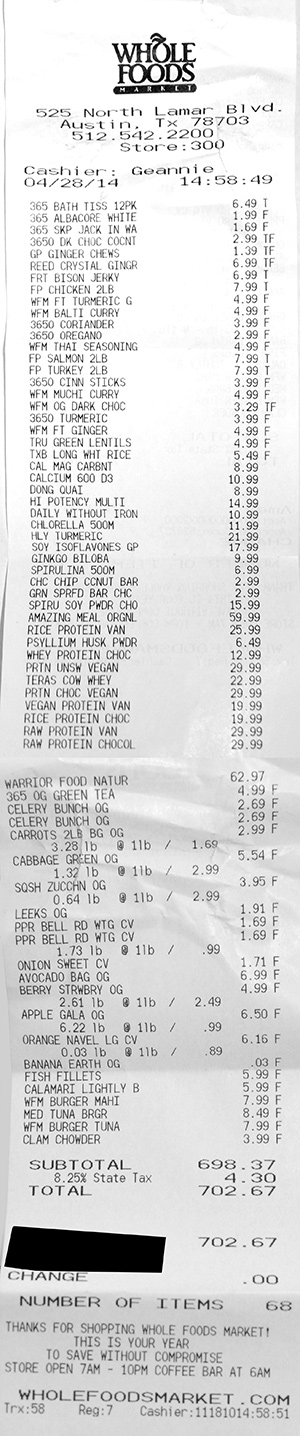
Just to make sure this is still going on, I went to the Whole Foods headquarters in Austin Texas last week and purchased nearly $700 worth of products (see the scan of my receipt, to the right). The receipt appears to be in two parts because Whole Foods prints items on the FRONT and the BACK of each receipt, so I had to stitch together two photos.
The results of testing these rice proteins in my ICP-MS laboratory -- the Natural News Forensic Food Labs -- once again confirms alarming levels of lead, cadmium and tungsten in multiple rice protein products sold by Whole Foods. If you're curious how I found tungsten in these products, click here to see the videos from our lab.
Here are just some of the results we found from rice proteins purchased at Whole Foods last week (1,000 ppb = 1 ppm)
Brown Rice Chocolate Protein (Lot #50696014) purchased at Whole Foods
Lead: 312 ppb (over 1,000% higher than California Prop 65 daily intake limit, based on serving size)
Cadmium: 1015 ppb
Tungsten: YES ("YES" means tungsten was detected at significant concentrations)
Raw Rice Protein Chocolate (Lot #I3553A #I3562) purchased at Whole Foods
Lead: 311 ppb (over 1400% higher than California Prop 65 daily intake limit, based on serving size)
Cadmium: 1731 ppb
Tungsten: YES

Read More Here


.....
Enhanced by Zemanta

GMO Update—Vermont Passes GMO Labeling Bill and Stands Up to Industry Bullying as New Research Confirms Safety Concerns


.....

By Dr. Mercola
In a recent article titled "Monsanto GM Soy is Scarier than You Think," Mother Jones1 went into some of the details surrounding our genetically engineered (GE) food supply.
Soybeans are the second-largest food crop grown in the US, and more than 90 percent of it is genetically engineered. Some have been modified to withstand the herbicide Roundup (i.e. Roundup-Ready soy), while other varieties have been designed to produce its own pesticide, courtesy of the Bt gene (so-called Bt soy).
As noted in the featured article, organic soy production is miniscule, accounting for less than one percent of the total acreage devoted to soy in the US. The rest is conventionally grown non-GE soy.
Even if you don't buy soy products such as tofu or soy milk, you're undoubtedly consuming plenty of soy if you're eating any processed foods and/or meats from animals raised in confined animal feeding operations (CAFOs). A large portion of the GE soy grown actually ends up in your meat, as soy is a staple of conventional livestock feed. Much of the rest ends up as vegetable oil.
According to the US Soy Board, soybean oil accounts for more than 60 percent of all the vegetable oil consumed in the US—most of which is used in processed foods and fast food preparation. As noted in the featured article:2
"Given soy's centrality to our food and agriculture systems, the findings of a new study published in the peer-reviewed journal Food Chemistry3 are worth pondering.
The authors found that Monsanto's ubiquitous Roundup Ready soybeans... contain more herbicide residues than their non-GMO counterparts. The team also found that the GM beans are nutritionally inferior."

New Research Questions Quality and Safety of GE Soybeans


Three varieties of Iowa-grown soybeans were investigated in this study:4
  1. Roundup Ready soybeans
  2. Non-GE, conventional soybeans grown using Roundup herbicide
  3. Organic soybeans, grown without agricultural chemicals
All of the Roundup Ready soybean samples were found to contain residues of glyphosate, which is the active ingredient in Roundup, along with its amino acid metabolite, aminomethylphosphonic acid (AMPA).
On average, GE soy contained 11.9 parts per million (ppm) of glyphosate. The highest residue level found was 20.1 ppm. Meanwhile, no residues of either kind were found in the conventional non-GE and organic varieties.
In terms of nutrition, organic soybeans contained slightly higher levels of protein and lower levels of omega-6, compared to both conventionally-grown non-GE and GE soy. Similar results were found in a 2012 nutritional analysis of GE corn, which was found to contain 13 ppm of glyphosate, compared to zero in non-GMO corn.
It may be worth noting that the US Environmental Protection Agency (EPA) actually raised the allowable levels of glyphosate5, 6 in oilseed crops such as soy, from 20 ppm to 40 ppm just last summer. It also raised the levels of permissible glyphosate contamination in other foods—many of which were raised to 15-25 times previous levels!

Why Glyphosate Contamination Matters


Nearly one BILLION pounds of Roundup are used each year for conventional crop production around the globe, but genetically engineered (GE) crops see some of the heaviest use. This is especially true for Roundup Ready crops, which are designed to withstand otherwise lethal doses of this chemical.
The issue of glyphosate contamination is well worth considering if you value your health. Recent research suggests glyphosate may in fact be an instrumental driver of many chronic diseases, and in my view, avoiding glyphosate is a major reason for buying organic, in and of itself.
Labeling GMOs could help you select products that are less likely to have heavy contamination, although you'd also avoid many other hazardous chemicals used in conventional farming by opting for products labeled 100% organic.
It's important to understand that these glyphosate residues CANNOT be washed off, as the chemical is actively integrated into every cell in the plant. Dr. Don Huber, who is one of the most prominent scientific experts in plant toxicology, firmly believes glyphosate is FAR more toxic and dangerous than DDT. A number of other studies have raised serious questions about the safety of glyphosate, including but not limited to the following:
  • Research published in the International Journal of Toxicology7 in January revealed that glyphosate-based formulations like Roundup pose a threat to human health through cytotoxicity and oxidative effects. Such formulations were also found to be lethal to human liver cells
  • A 2012 study8 found that 3 ppm of Roundup in water induced morphological changes in frogs
  • A German study9 on poultry, published in 2013, showed that glyphosate tends to be more harmful to beneficial gut bacteria like Lactobacillus, while pathogenic bacteria like Salmonella entritidi tend to be largely resistant to the chemical. Subsequently, the microbial balance tends to shift toward pathogenic overgrowth when exposed to glyphosate, and can predispose the animal to botulism

Victory! Vermont Passes First Effective GMO-Labeling Bill


On April 16, 2014, the Vermont Senate passed the first no-strings-attached GMO labeling bill (H.112) by an overwhelming margin—28-2. The bill sailed through a House/Senate conference committee and was approved by the House of Representatives on April 23.
Governor Shumlin has already indicated he will be signing the bill into law—which will require any genetically engineered food sold in Vermont to be labeled by July 1, 2016.10 Food served in restaurants, alcohol, meat, and dairy products would be exempt from labeling however. Foods containing GMO ingredients would also not be allowed to be labeled "natural."
"I am proud of Vermont for being the first state in the nation to ensure that Vermonters will know what is in their food," Governor Shumlin said in a statement. "The Legislature has spoken loud and clear through its passage of this bill. I wholeheartedly agree with them and look forward to signing this bill into law."
This is truly an historical moment that will likely reverberate across the US in coming years. As noted by Ronnie Cummins in a recent Huffington Post article:11
"Strictly speaking, Vermont's H.112 applies only to Vermont. But it will have the same impact on the marketplace as a federal law. Because national food and beverage companies and supermarkets will not likely risk the ire of their customers by admitting that many of the foods and brands they are selling in Vermont are genetically engineered, and deceptively labeled as 'natural' or 'all natural' while simultaneously trying to conceal this fact in the other 49 states and North American markets. As a seed executive for Monsanto admitted 20 years ago, 'If you put a label on genetically engineered food you might as well put a skull and crossbones on it.'"
The Burlington Free Press12 recently ran an excellent article on how the Vermont GMO labeling bill was won. I would highly encourage you to read it in its entirety, to get a real-world view of just how effective a grassroots campaign can be. It really boils down to letting your representatives know what you want. Despite the threat of a lawsuit from food manufacturers, Vermont legislators realized that their constituents were serious about wanting GMOs labeled. And they voted accordingly. Indeed, the chemical technology and food industry knows this, which is why they've fought tooth and nail to stop any and all GMO labeling efforts in the US. They've even threatened to sue any state that passes a labeling law—a threat taken seriously by Vermont.

Vermont Braces for Legal Challenge


Vermont Senate agreed to establish a state defense fund to pay for legal costs associated with defending the law against any legal challenge by the food industry, which will undoubtedly be spearheaded by the Grocery Manufacturers Association (GMA). It's unlikely that the industry would win such a legal challenge, however. As reported by the Burlington Free Press:13
"Rep. Teo Zagar, D-Barnard, told House members that... changes the Senate made will help the state prevail in court. 'This bill has been re-engineered to be more resistant to legal challenge,' he said."
As you may recall, after getting caught laundering money and narrowly defeating the Washington labeling campaign, the Grocery Manufacturers Association (GMA) sued the state of Washington, arguing they should be allowed to hide their donors—which is a direct violation of state campaign disclosure laws—in order to "speak with one voice" for the interests of the food industry.14 I subsequently named the GMA "the most evil corporation on the planet," considering the fact that it consists primarily of pesticide producers and junk food manufacturers who are hell-bent on violating some of your most basic rights, just to protect their own profits.
The GMA was initially forced to reveal their donors, but has since removed their online membership list—again hiding their members to prevent consumer awareness of who is behind this radical front group. You can find the cached members list on web.archive.org15 however. Not surprisingly, Pepsi, Coke, and Nestle—top purveyors of chronic ill health—were the top funders trying to hide their identity during the Washington State GMO labeling campaign.

Read More Here
Enhanced by Zemanta