Showing posts with label Radiation. Show all posts

Wednesday, December 23, 2015

Ever wonder if there are any measurable health issues or problems from exposure to Smart Meters and the electromagnetic frequencies they emit? The answer is , YES!


Activist Post

Interrupt Your Regularly Scheduled Program


Red Blood Cells and Smart Meters

smart_meter_blood

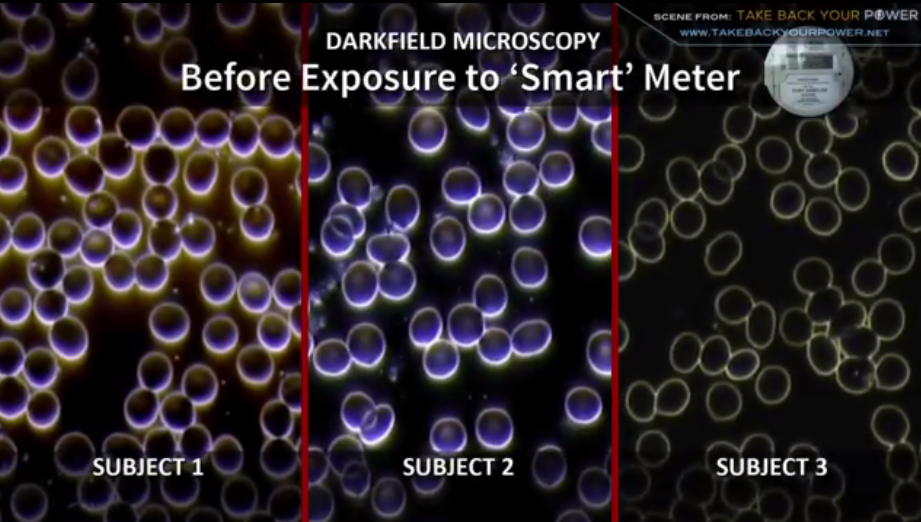
By Catherine J. Frompovich For those who wonder if there are any health issues or problems from exposure to Smart Meters and the electromagnetic frequencies they emit, here is a short video which shows three samples of blood examined using a Darkfield Microscope.


https://www.youtube.com/watch?feature=player_detailpage&v=y4JDEspdx58#t=5
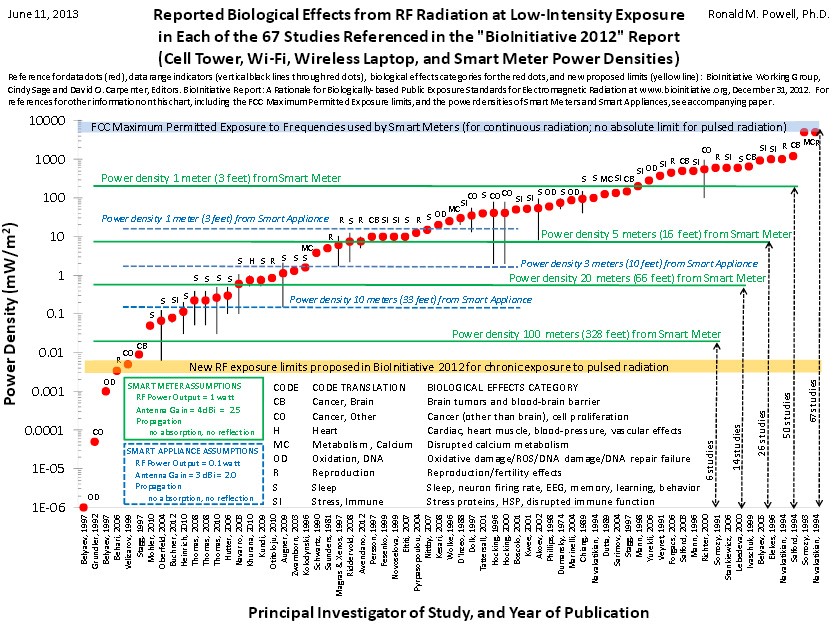
 
The video is self-explanatory, as the samples clearly show morphological responses or reactions. That kind of constant exposure with apparent human cellular morphological reactions—as will happen when a Smart Meter is placed on a dwelling—undoubtedly occurs, as EMFs/RFs are emitted 24/7/365. Consequently, it will be only a matter of time, depending upon each individual’s electromagnetic sensitivities threshold, before adverse health consequences materialize. Below is a chart created by EMF researcher Ronald M. Powell, PhD, which is self-explanatory? [3]

 
exposure chart    

The above graphic shows that 67 peer-reviewed, repeated studies show significant health issues (e.g. cancer, tumors, infertility) at levels far below the government safety standards (gray line). The yellow line is what the standards should be if public safety is considered. Source  


In another paper, “Electronicmagnetic Field Interactions With the Human Body: Observed Effects and Theories,” (NASA, April 1981) presented to the Goddard Space Flight Center, Greenbelt, Maryland 20771, on page 23, we find this:


Adverse, Benign, and Curious Effects The effects listed and/or discussed in this section relate to at least three of the five senses (touch, hearing, and sight) and nearly every system of the human body (including circulatory, digestive, nervous, and muscular). Many of them are temporary; however, some result in death and persistent disease. Some are better understood and more widely accepted than others. [1] [CJF emphasis added]


In 1981, NASA knew of numerous health problems, which are now classified as “Non-Thermal Health Effects,” which were cited on page 30 of that report:


  • Headaches
  • Eyestrain
  • Fatigue
  • Dizziness
  • Disturbed sleep at night
  • Sleepiness in daytime
  • Moodiness
  • Irritability
  • Unsociability
  • Hypochondriac reactions
  • Feelings of fear
  • Nervous tension
  • Mental depression
  • Memory impairment
  • Pulling sensation in the scalp and brow
  • Loss of hair
  • Pain in muscles and heart region
  • Breathing difficulties
  • Increased perspiration of extremities
  • Difficulty with sex life


 Read More Here

 .............................................................................................  


How to Make A Smart Meter Cover

  ..........     ..........
Published on Mar 20, 2014
This video will show you how to make a Smart Meter Cover if you have concerns about the health and safety standards of Smart Meter radiation. This faraday cage will significantly decrease the power level signals coming out the front and back of the smart meter. Using a mesh screen (aluminum or galvanized steel) will allow enough of the signal to pass so that your utility company can still read the meter.
  ..........

Tuesday, October 15, 2013

A compound derived from cruciferous vegetables, like cabbage, cauliflower and broccoli, protected rats and mice from lethal doses of radiation, Georgetown University Medical Center Researchers show

image host         File:Cruciferous Vegetables.jpg
Image source  :  Wikimedia  Commons
**************************************************************


Compound in Vegetables Protects Against Radiation

VOA News
Researchers at the Georgetown University Medical Center say their findings show that a compound derived from cruciferous vegetables, like cabbage, cauliflower and broccoli, protected rats and mice from lethal doses of radiation.
The researchers, in a study published today in the Proceedings of the National Academy of Sciences (PNAS), say that their findings suggests that DIM or Diindolylmethane may protect normal tissues during radiation therapy for cancer treatment and prevent or ease sickness caused by radiation exposure.
The compound is touted by some experts as a “super antioxidant” to help reduce inflammation in the body. Some also claim that DIM helps prevent several forms of cancer although research findings on this have been mixed.
"DIM has been studied as a cancer prevention agent for years, but this is the first indication that DIM can also act as a radiation protector," said the study's corresponding author, Eliot Rosen, MD, PhD, of the Georgetown Lombardi Comprehensive Cancer Center.
To reach their findings the researchers conducted experiments on rats and mice that were irradiated with lethal doses of gamma ray radiation.
Lab rats such as those pictured here were used to conduct research for the Georgetown University Medical Center study. (Sarah Fleming/Wikimedia Commons)Lab rats such as those pictured here were used to conduct research for the Georgetown University Medical Center study. (Sarah Fleming/Wikimedia Commons)
Some of the rats were injected with a dose of DIM 10 minutes after first being exposed to the radiation and were given an additional dose each day for two weeks.
The remaining rodents used in the experiment were not given the DIM and were left untreated.
Rosen said that the results of their experiments were “stunning”.  "All of the untreated rats died, but well over half of the DIM-treated animals remained alive 30 days after the radiation exposure," he said.
The researchers found that there was no real difference in the amount of protection offered by the DIM whether the first injection was given a day before or after their rodent test subjects were exposed to the gamma radiation.
The Georgetown team also found that there wasn’t as much of a reduction in red and white blood cells and platelets – common side effects in those who are undergoing radiation treatment for cancer - in the irradiated mice that were treated with DIM.
The researchers say that their work revealed two potential uses of the compound. "DIM could protect normal tissues in patients receiving radiation therapy for cancer, but could also protect individuals from the lethal consequences of a nuclear disaster," said Rosen.

Enhanced by Zemanta