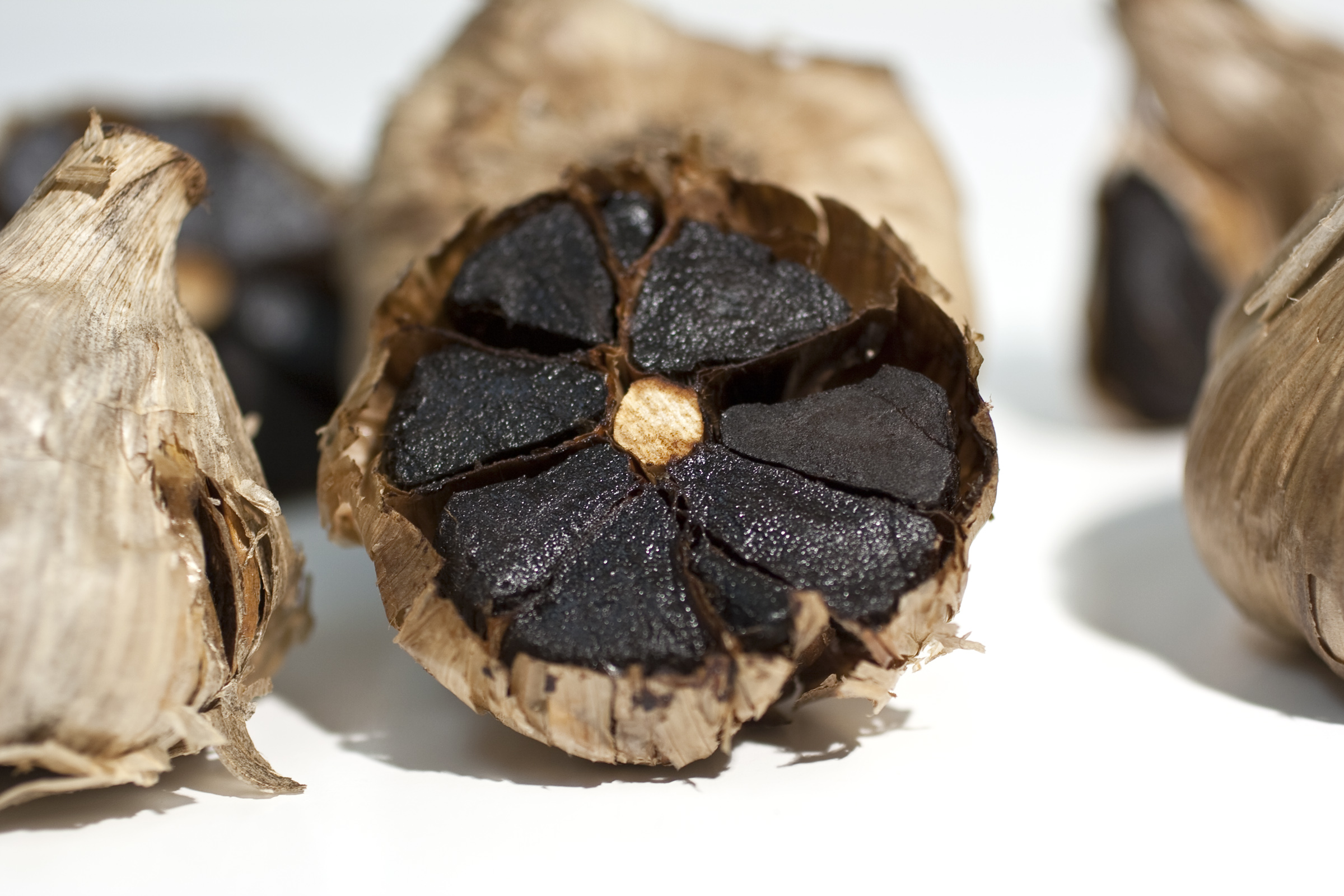
Black
garlic is a type of fermented garlic used as a food ingredient in Asian
cuisine. It is made by fermenting whole bulbs of garlic at high
temperature, a process that results in black cloves. The taste is sweet
and syrupy with hints of balsamic.
Author : Foodista
.....

Black Garlic and Sprouted Garlic Have Enhanced Health Benefits
April 21, 2014 | 159,564 views
Of all the foods Mother Nature provides, few foods offer more of a “botanical bonanza” for your health than garlic. Garlic is a bulbous root closely related to the onion, mentioned in historical documents dating back 5,000 years—before its fame wafted into the rest of the known world.
Speaking of wafting, garlic’s nickname “stinking rose” is well-deserved due to its undeniably pungent aroma that some find objectionable, but others find intoxicating.
Numerous studies show garlic’s amazing health potential in nearly every area of your body, from clogged arteries to gangrene to preventing insect bites and ear infections. There is even evidence that garlic is able to help slow your aging process. When it comes to this magical bulb, what’s not to love?
Purple Garlic Author : Itzuvit

Garlic Epitomizes a ‘Heart Healthy Food’
Like so many other complex plant foods, garlic contains a wide range of phytocompounds that act together to produce a wide variety of responses in your body. Garlic is rich in manganese, calcium, phosphorus, selenium, and vitamins B6 and C, so it’s beneficial for your bones as well as your thyroid.
Garlic also helps your body cleanse itself of heavy metals, such as lead, mercury, cadmium, and arsenic.1 Green Med Info has also assembled a list of studies demonstrating garlic's positive effects for more than 150 different diseases.2 In general, its benefits fall into four main categories:
The fact that garlic is so effective in fighting multiple types of cancer is probably related to its potent antioxidant effects. Garlic contains the precursors to allicin—a compound I’ll be discussing in detail shortly. Allicin is one of the most potent antioxidants from the plant kingdom.
- Reducing inflammation (reduces risk of osteoarthritis as mentioned in the video above)
- Boosting immune function (antibacterial, antifungal, antiviral, and antiparasitic properties)
- Improving cardiovascular health and circulation (protects against clotting, retards plaque, improves lipids, and reduces blood pressure)
- Toxic to 14 kinds of cancer cells (including brain, lung, breast, and pancreatic)
In fact, researchers have determined that sulfenic acid, produced during the rapid decomposition of allicin, reacts with and neutralizes free radicals faster than any other known compound—it’s almost instantaneous when the two molecules meet. And as an anti-infective, garlic has been demonstrated to kill everything from candida to herpes, MRSA, drug-resistant tuberculosis, and even HIV.
Garlic Bulbs Author : JJ Harrison (jjharrison89@facebook.com)

Garlic’s Secret Weapon: Allicin
Researchers have found that allicin is an effective natural "antibiotic" that can eradicate even antibiotic-resistant bugs. An added benefit is that the bacteria appear incapable of developing a resistance to the compound. However, the garlic must be fresh because the active agent is destroyed in less than an hour after smashing the garlic clove.
Garlic technically does not contain allicin, but rather, it contains two agents in separate compartments of the clove that react to form the sulfur-rich compound allicin when the plant needs it: alliin and an enzyme called allinase. So, what makes them react?
Garlic has a robust defense system to protect itself from insects and fungi. It enzymatically produces allicin within seconds when it is injured. The crushing of its tissues causes a chemical reaction between the alliin and the allinase, and allicin is produced—nature’s “insecticide.” This is what makes garlic such a potent anti-infective, as well as what produces that pungent aroma when you cut into it.
But allicin is short-lived, lasting less than an hour. Therefore, cooking, aging, crushing, and otherwise processing garlic causes allicin to immediately break down into other compounds, so it’s difficult to get allicin up to biologically active levels in your body.3
Plus, an Army of Sulfur-Rich Phytochemicals
More than 100 different compounds have been identified in garlic, some of which come from the rapid breakdown of allicin itself. The absorption, metabolism, and biological effects of all these compounds are only partially understood. So, although garlic is known to possess a wealth of health benefits, we still do not know exactly which benefits come from which compounds, what compounds get into which tissues, etc.
As powerful as allicin is as an anti-infective, it only makes sense that garlic’s other health effects come from the synergism of those many OTHER compounds. This is a complicated topic, and if you want to explore it further, the Oregon State’s Linus Pauling Institute has a comprehensive article in their online Micronutrient Information Center.4
Read More and Watch Videos Here