
Prostate cancer tests underestimate aggressiveness of disease, says study
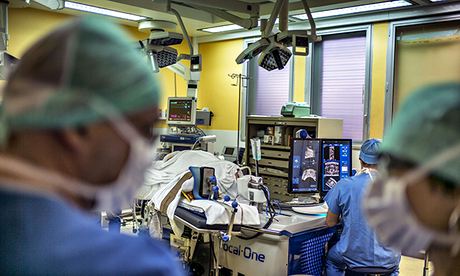
A
surgeon sitting in front of screens of a Focal One device performs a
robot-assisted prostate tumorectomy. Photograph: Jeff Pachoud/AFP/Getty
Images
Men with prostate cancer are being given false hope by tests that underestimate the aggressiveness of their disease, according to a study.
Researchers found that more than half of a group of men whose cancers were initially classified as slow-growing and confined later turned out to have more dangerous tumours.
The findings, published in the British Journal of Cancer, call into question the ability of experts to grade and stage prostate cancers on the basis of biopsy samples.
It also casts doubt on the "active surveillance" strategy of avoiding unnecessary radical treatment for patients with slow-growing prostate cancer.
Instead, these patients are closely monitored but left alone until tests suggest their condition has worsened.
Urological surgeon Greg Shaw, from the Cancer Research UK Cambridge Institute, said: "Our results show that the severity of up to half of men's prostate cancers may be underestimated when relying on tests before they have surgery."
Slow-growing prostate cancers, known as "pussycats", are very different from the more aggressive "tiger" variety.
In some cases, especially when he is older when diagnosed, a patient can live to the end of his normal life span before a "pussycat" cancer becomes a threat.
An aggressive "tiger", on the other hand, may quickly spread if it is not surgically removed or destroyed.
Biopsy samples examined under a microscope are used to rate prostate tumour aggressiveness with a score ranging from two to 10. A score of between two and six is a low-grade "pussycat". A score of seven is intermediate, while scores of eight to 10 are high-grade "tigers".
Tumours are also staged according to how far they have spread. A T2 tumour is contained completely inside the prostate gland, while a T3 tumour has started to break out, and one classified T4 has spread to other organs or sites in the pelvic cavity.
The Cambridge scientists compared the staging and grading of more than 800 men's cancers before and after they had surgery to remove their prostate.
They found that of 415 patients whose cancer was classified as slow-growing and confined to the prostate, just over half (209) were found to have a more aggressive disease than originally thought when assessed after surgery.
Read More Here
Researchers found that more than half of a group of men whose cancers were initially classified as slow-growing and confined later turned out to have more dangerous tumours.
The findings, published in the British Journal of Cancer, call into question the ability of experts to grade and stage prostate cancers on the basis of biopsy samples.
It also casts doubt on the "active surveillance" strategy of avoiding unnecessary radical treatment for patients with slow-growing prostate cancer.
Instead, these patients are closely monitored but left alone until tests suggest their condition has worsened.
Urological surgeon Greg Shaw, from the Cancer Research UK Cambridge Institute, said: "Our results show that the severity of up to half of men's prostate cancers may be underestimated when relying on tests before they have surgery."
Slow-growing prostate cancers, known as "pussycats", are very different from the more aggressive "tiger" variety.
In some cases, especially when he is older when diagnosed, a patient can live to the end of his normal life span before a "pussycat" cancer becomes a threat.
An aggressive "tiger", on the other hand, may quickly spread if it is not surgically removed or destroyed.
Biopsy samples examined under a microscope are used to rate prostate tumour aggressiveness with a score ranging from two to 10. A score of between two and six is a low-grade "pussycat". A score of seven is intermediate, while scores of eight to 10 are high-grade "tigers".
Tumours are also staged according to how far they have spread. A T2 tumour is contained completely inside the prostate gland, while a T3 tumour has started to break out, and one classified T4 has spread to other organs or sites in the pelvic cavity.
The Cambridge scientists compared the staging and grading of more than 800 men's cancers before and after they had surgery to remove their prostate.
They found that of 415 patients whose cancer was classified as slow-growing and confined to the prostate, just over half (209) were found to have a more aggressive disease than originally thought when assessed after surgery.
Read More Here
Related articles


