Showing posts with label The Human Mind. Show all posts

Thursday, December 12, 2013

How Technology Is Warping Your Memory

The Huffington Post  |  By Posted:   |  Updated: 12/12/2013 4:05 am EST


Take a moment to think about the last time you memorized someone's phone number. Was it way back when, perhaps circa 2001? And when was the last time you were at a dinner party or having a conversation with friends, when you whipped out your smartphone to Google the answer to someone's question? Probably last week.

Technology changes the way we live our daily lives, the way we learn, and the way we use our faculties of attention -- and a growing body of research has suggested that it may have profound effects on our memories (particularly the short-term, or working, memory), altering and in some cases impairing its function.

The implications of a poor working memory on our brain functioning and overall intelligence levels are difficult to over-estimate.

"The depth of our intelligence hinges on our ability to transfer information from working memory, the scratch pad of consciousness, to long-term memory, the mind’s filing system," Nicholas Carr, author of The Shallows: What The Internet Is Doing To Our Brains, wrote in Wired in 2010. "When facts and experiences enter our long-term memory, we are able to weave them into the complex ideas that give richness to our thought."

While our long-term memory has a nearly unlimited capacity, the short-term memory has more limited storage, and that storage is very fragile. "A break in our attention can sweep its contents from our mind," Carr explains.

Meanwhile, new research has found that taking photos -- an increasingly ubiquitous practice in our smartphone-obsessed culture -- actually hinders our ability to remember that which we're capturing on camera.

Concerned about premature memory loss? You probably should be. Here are five things you should know about the way technology is affecting your memory.

Information overload makes it harder to retain information.

water overflowing

Even a single session of Internet usage can make it more difficult to file away information in your memory, says Erik Fransén, computer science professor at Sweden's KTH Royal Institute of Technology. And according to Tony Schwartz, productivity expert and author of The Way We're Working Isn't Working, most of us aren't able to effectively manage the overload of information we're constantly bombarded with.

When the working memory is experiencing digital overload, it's like a glass of water overflowing. Schwartz explained in an interview with The Huffington Post in June:

"It’s like having water poured into a glass continuously all day long, so whatever was there at the top has to spill out as the new water comes down. We’re constantly losing the information that’s just come in -- we’re constantly replacing it, and there’s no place to hold what you’ve already gotten. It makes for a very superficial experience; you’ve only got whatever’s in your mind at the moment. And it’s hard for people to metabolize and make sense of the information because there’s so much coming at them and they’re so drawn to it. You end up feeling overwhelmed because what you have is an endless amount of facts without a way of connecting them into a meaningful story."

The Internet is becoming the brain's "external hard drive."

google search plus your world

Research has found that when we know a digital device or tool will remember a piece of information for us, we're less likely to remember it ourselves. A recent Scientific American article likened the Internet to the brain's "external hard drive," explaining that the social aspect of remembering has been replaced by new digital tools.

Read More Here

Enhanced by Zemanta

Thursday, October 31, 2013

Groundbreaking research nearly two decades ago demonstrating the adverse effects of poverty.


How Poverty Molds the Brain: Poor Neural Processing of Sound Linked to Lower Maternal Education Background


Oct. 29, 2013 — Groundbreaking research nearly two decades ago linking a mother's educational background to her children's literacy and cognitive abilities stands out among decades of social science studies demonstrating the adverse effects of poverty.
Now new research conducted at Northwestern University has taken that finding in a neuroscientific direction: linking poor processing of auditory information in the adolescent brain to a lower maternal educational background.
"These adolescents had noisier neural activity than their classmates, even when no sound was presented," said Nina Kraus, the Hugh Knowles Professor of Neurobiology, Physiology and Communication Sciences at Northwestern and corresponding author of the study.
In addition, the neural response to speech for the adolescents from a lower maternal educational background was erratic over repeated stimulation, with lower fidelity to the incoming sound.
"Think about the neural noise like static in a radio -- with the announcer's voice coming in faintly," Kraus said.
Maternal education acted as a proxy for socioeconomic status for the study. Adolescents were divided into two groups, according to whether their mothers had a high school education or less or had completed some post-secondary schooling.
Not only did the adolescents from a lower maternal educational background have neural responses to speech sounds that were nosier, more variable and represented the input signal weakly, but their performances on tests of reading and working memory also were poorer.
"The impoverished brain: Disparities in maternal education affect the neural response to sound" will be published Oct. 30 in the Journal of Neuroscience. Its authors are Erika Skoe, assistant professor of speech, language and hearing sciences at the University of Connecticut; Jennifer Krizman, a doctoral student in Northwestern's Auditory Neuroscience Laboratory; and Kraus, also the director of the Auditory Neuroscience Lab.
This study builds on evidence that children from low-income families experience a type of auditory impoverishment. The landmark study by Hart and Risley (1995) revealed that children in high-income families are exposed to 30 million more words than children from families on welfare. This reduction in the quality and quantity of language input, along with greater exposure to unstructured sound such as ambient noise, may be affecting how the brain represents auditory information.
In urban populations, income and amount of noise exposure are known to be correlated. Consistent with the idea that noisy auditory environments increase neural noise, the new Journal of Neuroscience study found that the adolescents from the lower maternal educational group have increased neural activity in the absence of sound input.
According to the study, "Neural models indicate that when the input to a neuron is noisier, the firing rate becomes more variable, ultimately limiting the amount of sensory information that can be transmitted."
"If your brain is creating a different signal each time you hear a sound, you might be losing some of the details of the sound," said Skoe, lead author of the study. "Losing these details may create challenges in the classroom and other noisy settings."
The new research conducted at Northwestern contributes to a recent wave of neuroscientific research demonstrating that sociocultural factors influence brain structure and function.
Another recently published study from the Kraus lab showed that inconsistent neural responses to sounds relate to poor reading but that by acoustically augmenting the classroom, neural responses became more stable.
"Modifying the auditory world for a particular student, even if just for a portion of the day, may improve academic performance and fine-tune how sound is automatically encoded in the brain," Skoe said.
Ongoing work in Northwestern's Auditory Neuroscience Laboratory is investigating whether auditory enrichment in the form of music education and other school-based activities can offset the negative impact of an impoverished acoustic environment.
For the new study, brain activity of Chicago Public School adolescents, almost all ninth-graders, was assessed both in response to and in the absence of auditory input. The nervous system's responses to speech sounds were observed through passive electrophysiological recordings, with students grouped according to the highest educational level achieved by their mothers.
The responses reflect activity from a communication hub within the central nervous system that provides a snapshot of sensory, cognitive and reward circuits that are engaged to process sound. These fundamental, automatic responses to sound reflect past and ongoing sensory experiences and relate to linguistic and cognitive function.
The collection protocol for "the impoverished auditory brain" lasted roughly 20 minutes, during which participants sat comfortably watching a self-selected subtitled movie, while the brain response to speech syllables was passively collected.
The syllables were presented at a rapid rate to the right ear through an earphone placed in the ear canal. The left ear remained unblocked, making the movie sound track audible yet not intense enough to mask the stimulus.
The syllables chosen are common to many languages of the world, and their acoustic characteristics are perceptually challenging.
In addition, IQ assessments for the students were collected, and they were administered a standardized, age-normed test battery of reading ability and executive function (working memory). Previous work has revealed that the neurobiological systems mediating higher order functions such as language, memory and executive function are especially sensitive to disparities in socioeconomic status.
"By studying socioeconomic status within a neuroscientific framework, we have the potential to expand our understanding of the biological signatures of poverty," Kraus concluded. "And a better understanding of how experiences shape the brain could inform educational efforts aimed at closing the socioeconomic achievement gap."

Story Source:
The above story is based on materials provided by Northwestern University. The original article was written by Pat Vaughan Tremmel.
Note: Materials may be edited for content and length. For further information, please contact the source cited above.

Journal Reference:
  1. Skoe E, Krizman J, Kraus N. The impoverished brain: Disparities in maternal education affect the neural response to sound. Journal of Neuroscience, 2013
Enhanced by Zemanta

Tuesday, July 30, 2013

A team of MIT researchers have figured out how to hack the brain.

File:DARPA Big Data.jpg

Image Source :  WIkimedia Commons
*****************************************************************

The Frightening New Mind Control Technology That Can Hack Your Brain

Daniel G. J.

StoryLeak

by
July 28th, 2013
Updated 07/29/2013 at 2:58 am

There’s a frightening new technology at the Massachusetts Institute of Technology (MIT) that’s right out of a comic book. Scientists at the technical school have figured out how to implant false mental reactions in a mouse.
This technological ‘advancement’ is terrifying when considering that it could lead to real life brainwashing and mind control like that shown in the classic movie The Manchurian Candidate (the classic film starring Frank Sinatra). In the film, communists turn an average man into an assassin by implanting false memories into his mind.
A similar plot is found in Total Recall. The brainwashing shown in these movies were fantasy, but what’s happening at MIT is apparently real.
A team of MIT researchers led by neuroscientist Susumu Tongawa figured out how to implant responses in the brains of mice by manipulating neurons. They even have a name for their technique, optogenetics, and it allows them to manipulate brain cells with chemicals. Remember the term optogenetics; we’re going to be hearing a lot about it in years to come.

Brain Hacking

Basically, these scientists have figured out how to hack the brain much like cyber crooks can hack your computer. They’re still a long way from hacking human brains, but that seems to be the goal here.


Read More Here


Enhanced by Zemanta

Saturday, July 27, 2013

New FDA approved “brain test” for ADHD—is bogus

Citizens Commission on Human Rights International

By Kelly Patricia O’Meara
July 23, 2013


Given the enormous potential for great harm, one has to wonder how the Food and Drug Administration, FDA, gets away with giving its stamp of approval on a new “brain wave test,” that allegedly will “help confirm an ADHD diagnosis,” when there is no scientific or medical proof that any physical abnormality exists.
In fact, the mandate of the FDA demands the opposite of its latest approval action. According to the FDA website, the federal agency is tasked with protecting “the public health by assuring the safety, effectiveness, and security of human and veterinary drugs, vaccines and other biological products for human use and medical devices.”
What part of approving a “brain waive test” for a psychiatric diagnosis that doesn’t exist is “assuring the safety and effectiveness?” More to the point, since there is no proof that the alleged psychiatric diagnosis exists, how can the FDA possibly claim that any test, least of all one that consists of interpreting squiggly lines on a piece of paper, is safe or effective? Is this a case of group-think? The FDA heard, has been told, believes ADHD exists?


This kind of thinking is so two months ago. Remember it was just before the American Psychiatric Association (APA), held its annual get-together in May that the National Institute of Mental Health, NIMH, slammed the door on the APA’s Diagnostic and Statistical Manual of Mental Disorders (DSM) which includes “ADHD,” stating the manual is “at best, a dictionary, creating a set of labels and defining each.”
The NIMH further explained that the APA’s diagnoses “are based on a consensus about clusters of clinical symptoms, not any objective laboratory measure…” and “the weakness is its lack of validity.”
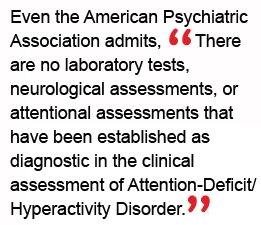
And the APA, itself, writes, “There are no laboratory tests, neurological assessments, or attentional assessments that have been established as diagnostic in the clinical assessment of Attention-Deficit/Hyperactivity Disorder.” Okay, seems pretty clear. The ADHD diagnosis is completely subjective and not based in science.


The FDA ignored these facts and, in what appears to be an irresponsible attempt to validate ADHD as a science-based psychiatric diagnosis, has opened the floodgates for creating more victims and the already epidemic numbers of children being diagnosed with the alleged ADHD will skyrocket.
According to the Centers for Disease Control and Prevention, CDC, there has been a 41 percent increase in the diagnosis of ADHD over the past decade and one in five high school boys (11 percent of all school-age children) have received the non-scientific diagnosis.
More troubling is that based on a 100 percent subjective ADHD diagnosis, nearly 3 million American children are currently taking prescription mind-altering drugs as “treatment” that are the equivalent of cocaine, carrying serious adverse reactions.
And aside from the fact that there is zero proof that ADHD is an abnormality of the brain, the FDA’s approval of the new EEG device called, “Neuropsychiatric EEG-Based Assessment Aid,” the NEBA System, is suspect on a number of levels, including its blatant lack of information about the data used to decide on approval.


Read More Here


Enhanced by Zemanta

Sunday, July 21, 2013

“Neural Dust: The Smart Dust Could Be Used To Monitor Human Thought

How Smart Dust Could Be Used To Monitor Human Thought

Elise Ackerman, Contributor  

A few years ago a team of researchers from Brown University made headlines after they successfully demonstrated how a paralyzed woman who had lost the use of her arms and legs could control a robotic arm using her brainwaves. In a video, Cathy Hutchinson imagines drinking a cup of coffee, and the robotic arm brings the cup to her lips.


The scene is amazing, but also a little disturbing. Hutchinson is connected to the robotic arm through a rod-like “pedestal” driven into her skull. At one end of the pedestal, a bundle of gold wires is attached to a tiny array of microelectrodes that is implanted in the primary motor cortex of Hutchison’s brain. This sensor, which is about the size of a baby aspirin, records her neural activity. At the other end of the pedestal is an external cable that transmits neural data to a nearby computer, which translates the signals into code that guides the robotic arm.

This method, known as BrainGate, pretty much defined state-of-the-art brain-computer interfaces at the end of the last decade. If the idea of a rod-through-the-head computer interface makes you cringe, you are not alone.

 For some time, a small team of researchers at UC Berkeley has been working on plans for a less invasive, wireless monitoring system. Earlier this month, they released a draft paper: “Neural Dust: An Ultrasonic, Low Power Solution for Chronic Brain-Machine Interfaces.”  

Read More Here

 
Enhanced by Zemanta